AI Strategy · Infrastructure · Unit Economics
Data centers now pay their own power bill. So will your AI
States are making data centers carry the cost and risk of their electricity, with 12-year contracts and collateral. What that means for AI costs.
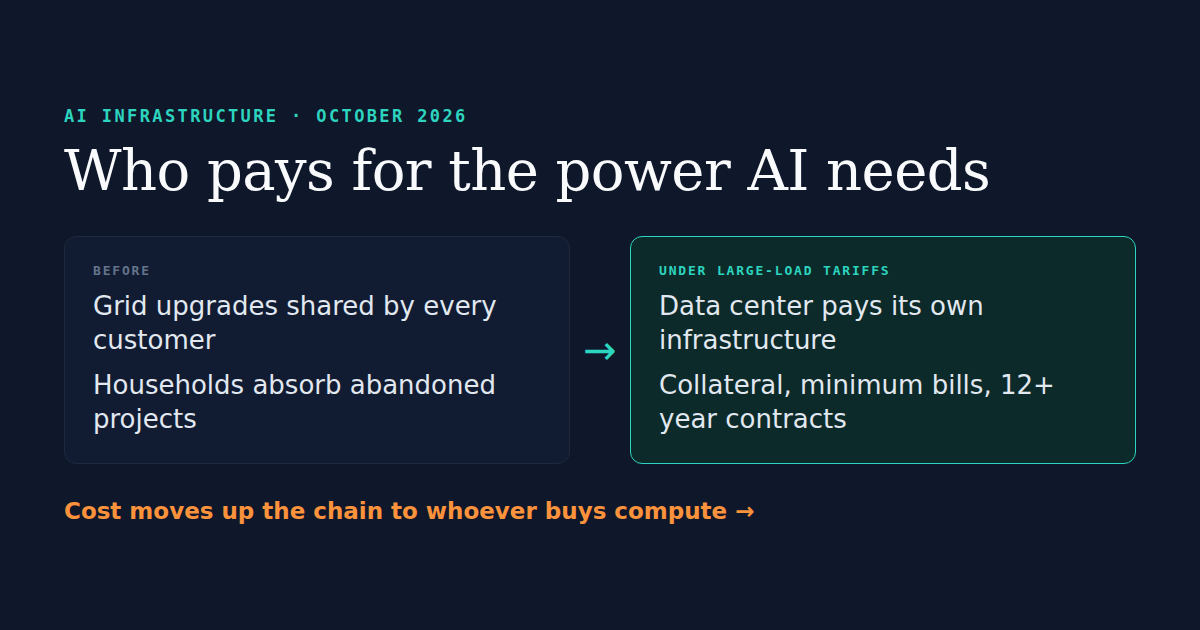
Two-thirds of Americans now oppose building new data centers, according to a Washington Post-ABC-Ipsos poll reported on 21 October 2026. The same morning, the president wrote that new data centers are "mandated by me to make their own electricity." Behind the politics there is a quieter change that matters more to anyone building AI products: states are rewriting electricity contracts so that data centers, not households, carry the cost and the risk of the power they need.
AI inference got cheaper this year. The electricity under it is starting to arrive with a data center's name on the bill and a 12-year contract attached. That cost doesn't disappear. It moves up the chain toward whoever buys compute.
What changed
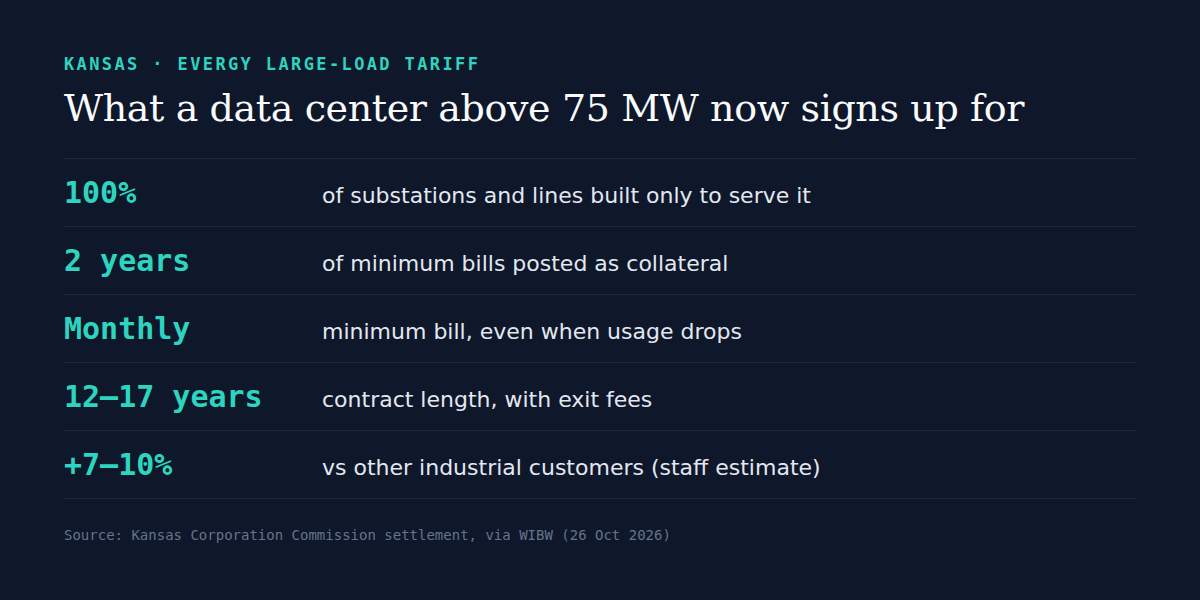
The clearest example is Kansas. Under a rate plan approved by the Kansas Corporation Commission in a unanimous settlement, the utility Evergy now applies these terms to "large-load" customers, those with peak demand above 75 megawatts, including data centers:
- They pay the full cost of substations and transmission lines built only to serve them.
- They post collateral equal to two years of their minimum bills, in case a project is delayed, downsized or abandoned.
- They pay a monthly minimum even in months they use less power than planned.
- Contracts run at least 12 years, up to 17 with a phase-in, with exit fees for leaving early.
- They pay higher rates than other large industrial customers. Commission staff estimated 7% to 10% more.
North Carolina is moving the same way. Governor Josh Stein wants regulators to impose "large load" tariffs on data center operators so they pay for "the energy generation and transmission costs that they put onto the system." The state's attorney general wants data centers treated as "a separate rate class." The state utilities commission is finalizing a settlement with Duke Energy that already includes upfront payment for upgrades and minimum purchase requirements.
The political reason is plain. A single planned data center in Independence, Kansas, will need more than 800 megawatts once fully running, per the same report. Someone has to pay for the new lines and plants that loads like that require, and households don't want it to be them.
The mechanism: who carries the risk
Before these rules, a utility building for a data center spread much of that investment across all its customers. If the project shrank or moved, everyone else was left paying for capacity nobody used. The new contracts reverse that. They turn a data center's electricity from a variable cost into a long-term commitment with collateral behind it.
That changes the economics for the companies that run AI infrastructure in three ways.
- Power becomes a fixed, long-dated cost. A 12-to-17-year contract with a monthly minimum doesn't shrink when demand dips. Operators have to price that commitment into what they sell.
- Speculative capacity gets expensive. Posting two years of minimum bills as collateral makes "build first, find customers later" a costlier bet. Some capacity that would have been built on hope won't be.
- Location starts to matter. Rules differ by state and utility. Where power is cheap, fast and politically welcome, capacity will cluster. Where it isn't, it will lag.
None of this means your AI bill goes up next month. Our reading is narrower: the long-run floor under the cost of inference is electricity, and that floor is now being priced explicitly and for decades. Prices have been falling as models and chips improve. Power is the part of the stack where costs are now being written into long contracts instead.
Why this matters if you build with AI
Most product teams treat AI as an API with a price per token that only goes down. That assumption has held so far. It's worth not building a business that depends on it holding forever.
We've argued before that hardcoding one AI model is already technical debt. The same logic applies to cost. If a feature only works at today's price per call, it carries a risk nobody wrote down. The teams that handle a price change well are the ones that can see their cost per feature and switch models without a rewrite.
What to do now
- Know your cost per feature, not just your monthly AI bill. Track what each AI-powered feature costs per use and per customer. You can't decide what to change if you can't see which feature drives the spend.
- Design for a smaller model. For each feature, know the cheapest model that does the job well enough. Routing routine calls to a smaller model is usually the largest cost lever you have.
- Keep the provider swappable. An abstraction layer and an evaluation set let you move between providers when prices or capacity change, instead of absorbing whatever the current one charges.
- Price with room. If your margin on an AI feature only works at today's inference prices, build in headroom or a usage limit before you scale it.
- Watch where your capacity lives. If you run your own GPUs or sign reserved-capacity deals, ask where the power comes from and on what terms. That's now part of the price.
| Before the new rules | Under large-load tariffs (Kansas example) |
|---|---|
| Grid upgrades shared across all customers | Data center pays 100% of dedicated infrastructure |
| Usage-based bills | Monthly minimum, even when usage drops |
| Shorter commitments | 12 to 17 years, with exit fees |
| Risk of abandoned projects falls on households | Collateral of two years of minimum bills |
| Industrial rate | Estimated 7% to 10% above other industrial customers |
Keeping AI features economical as the underlying costs shift is a regular part of our production work: knowing what each call costs, and having a plan for when that number moves.
Key takeaways
- A Washington Post-ABC-Ipsos poll found 66% of Americans oppose building new data centers, and political pressure on their power costs is rising.
- Kansas now requires data centers above 75 MW to pay for their dedicated infrastructure, post two years of minimum bills as collateral, pay a monthly minimum and sign 12-to-17-year contracts. North Carolina is moving toward similar tariffs.
- These rules move the cost and risk of new power from households to data center operators, who will price it into what they sell.
- For product teams: track cost per feature, design for smaller models, keep providers swappable and don't build margins that need inference prices to keep falling.
FAQ
Are data centers raising household electricity bills? That's the political fear driving these rules. Utilities and regulators in states like Kansas say the new tariffs are designed so data centers pay their own way. Whether that holds will show up in future rate cases.
Will AI get more expensive because of this? Not necessarily soon. Model and hardware improvements have been driving prices down. But electricity is now being priced into long contracts with minimums and collateral, so it's less likely to be the part of the cost that keeps falling.
What is a large-load tariff? A separate set of electricity terms for very large customers, such as data centers. In Kansas it applies above 75 megawatts of peak demand and includes long contracts, minimum bills and collateral.
What should a startup using AI APIs do about this? Make cost visible per feature, know which smaller models can do each job, and keep the ability to switch providers. Those steps protect your margins whatever happens to prices.