Cloud Costs · AI Infrastructure · GPU
H100 Cloud Pricing: Your Billing Tier, Not Your Vendor
The viral 4.57x H100 price spread compares vendors. Inside one Azure SKU the same GPU is 5.41x apart, and the billing tier is what sets your bill.
A chart went around this week with one chip and four prices. The same H100, rented from four providers, at $2.69, $3.99, $6.88 and $12.29 per GPU-hour — 4.57x between the cheapest and the dearest. At the top of that range a single GPU costs about $8,972 a month. At the bottom, about $1,964. If somebody forwarded it to you with "why are we paying this", you are the person this post is for.
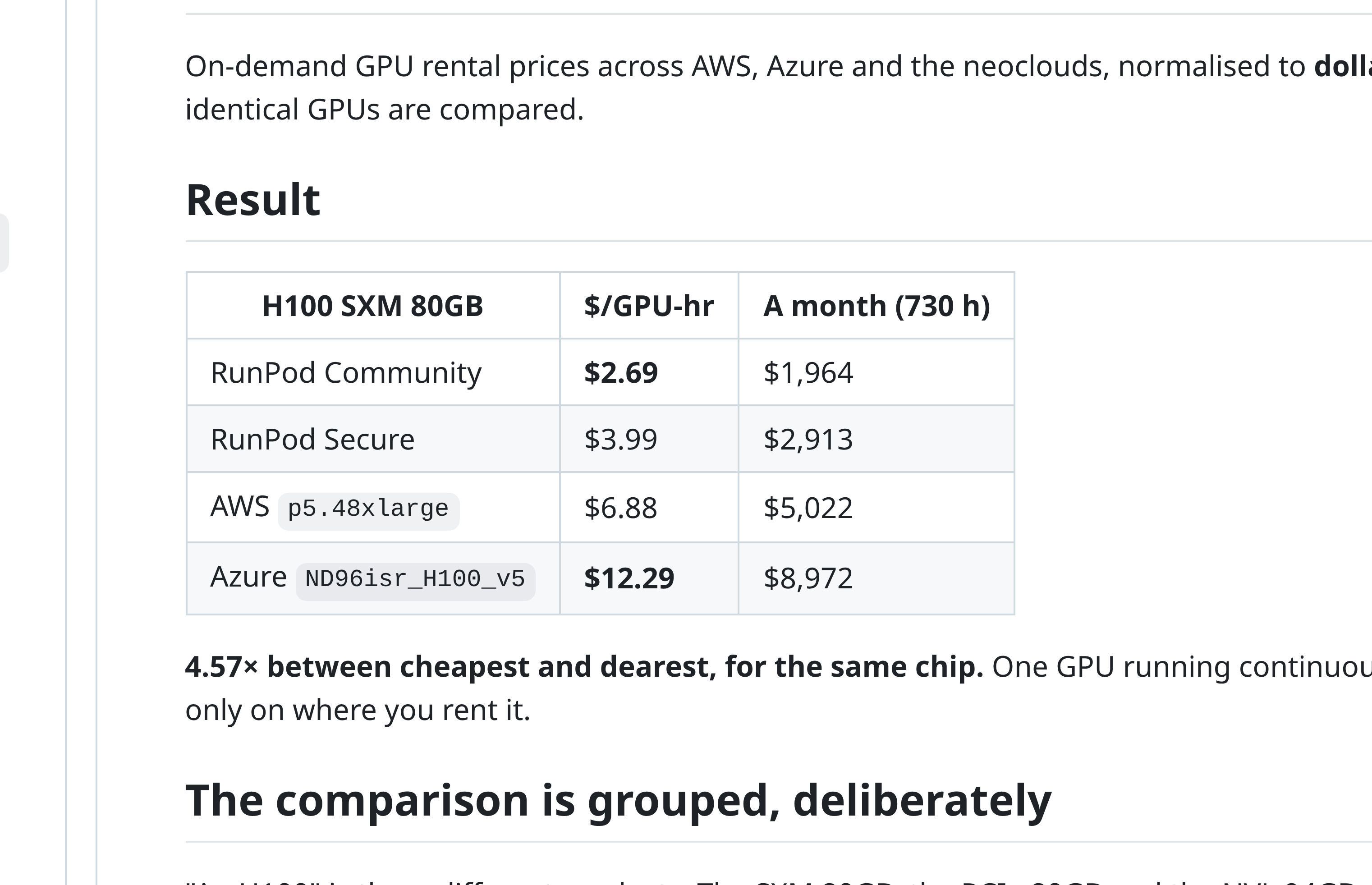
The chart is careful work. It groups by SXM, PCIe and NVL so it is not quietly comparing different chips, it publishes its collection scripts, and every figure in it reproduces when you query the vendors yourself — we did, on 9 November. It also says, in its own Limitations section, that it compares on-demand list prices only, and that "spot in particular would narrow the gap a lot."
Nobody who forwarded it read that far, and nobody priced that caveat. We priced it, and pricing it inverts the ranking. Inside Azure alone — one SKU, one region, one Linux image — the same H100 is $12.29 or $2.27 per GPU-hour depending on which billing tier you buy. That is a 5.41x spread inside a single vendor, wider than the whole 4.57x the chart is about.
You are about to pull the smaller lever
Acting on the chart as written means a migration: a second environment to operate for as long as both exist, new images and drivers, data egress, and the loss of a datacenter SLA — the cheapest row is RunPod's Community Cloud — third-party hosts, which is the source repository's description of that tier, not RunPod's. You pay all of that to capture 4.57x.
The 5.41x needs no provider change. Same hardware, same account, interconnect and SLA included. You buy it with engineering work rather than a signature: jobs that checkpoint and resume, and a term commitment you are willing to sign.
Be clear about one thing before these numbers go into a model. Every figure here is a provider's own published list rate, read from their pricing endpoints on 9 November 2026. The spot and reserved rates are published prices, not realised costs. We did not test whether H100 spot capacity is obtainable in East US, did not measure an eviction rate, and did not verify that a three-year reservation can be bought today. The chart's sharpest limitation — a cheap H100 you cannot get is not a price — applies hardest to the tier our argument rests on, and capacity, not price, is what has been running out. Treat $2.27 as a ceiling on your savings, never as your bill.
Same chip, same region, four prices
A cloud GPU is not one product with one price. It is the same silicon sold at four billing tiers, and the tier is the variable almost nobody puts in the comparison.
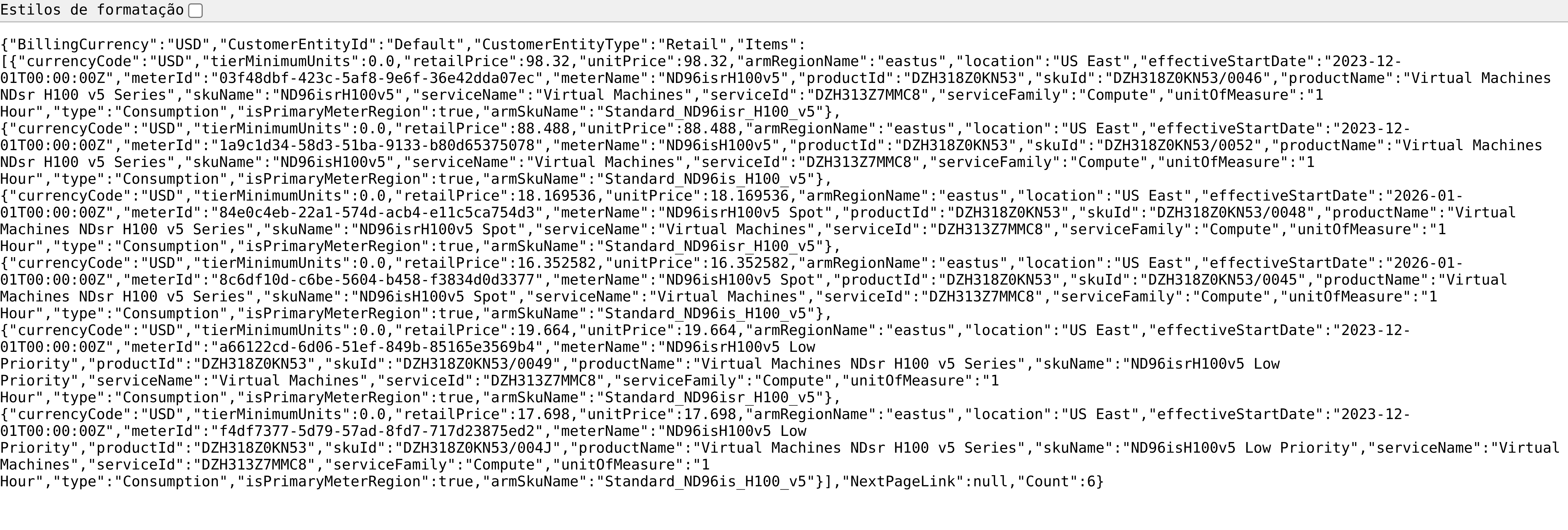
Azure's Retail Prices API, queried for East US, returns one SKU — Standard_ND96isr_H100_v5, eight H100 SXM 80GB with InfiniBand — at $98.32 per hour pay-as-you-go and $18.17 per hour on spot. Divided by the eight GPUs in the node: $12.29 and $2.27 per GPU-hour. The rows differ by nothing but the tier. Same product name, same region, same Linux image, no end date on either.
The same query adds a Low Priority tier at $2.46 per GPU-hour, and a sibling SKU without InfiniBand at $11.06 — which prices the fabric itself at about $1.23 per GPU-hour. Train across nodes and that line item is what makes the cluster work. Serve single-node inference and you have been renting it anyway.
AWS tells the same story. The bulk price list for us-east-1 puts p5.48xlarge at $55.04 per hour on demand, $6.88 per GPU-hour, reproducing the chart exactly. The three-year standard all-upfront reservation on the same instance is $543,866 at signing with a $0.00 hourly rate, amortising to $2.59 per GPU-hour. That is a 2.66x spread inside AWS, and it lands level with the chart's cheapest provider on a node with 3,200 Gbps of networking.
| What you promise | Azure ND96isr H100 v5 | AWS p5.48xlarge |
|---|---|---|
| Nothing (on demand) | $12.29 /GPU-hr | $6.88 /GPU-hr |
| Low priority | $2.46 /GPU-hr | — |
| Interruptibility (spot) | $2.27 /GPU-hr | — |
| Three years, paid upfront | — | $2.59 /GPU-hr |
Read the columns and you are comparing providers. Read the rows and you are comparing promises. The rows move more.
The cheap tier is bought with code
A spot H100 can be reclaimed mid-run. That is the whole catch, and it is why the low number is not something you can sign for. You only pay it if your job can die at an arbitrary moment and resume without losing the work — a property of your code, not of your contract.
For training that means checkpoint cadence, and the arithmetic is simple. If a checkpoint costs two minutes of wall clock and you write one every thirty, an eviction costs at worst those thirty-two minutes plus however long you queue for replacement capacity. You are saving about $10.02 per GPU-hour and the wasted time is billed at the $2.27 spot rate, so an eviction has to waste roughly four hours of the node to erase a single hour of savings. For inference, restartability means draining connections, warm replicas, and usually a floor of on-demand capacity underneath — a real cost that goes back into the model.
That is the honest version of the decision, and it is the kind of work we do taking an AI-built service to production: not a better price, a workload that qualifies for one.
Ask which tier before you compare
AI cost reporting keeps producing spreads that measure the wrong axis. When the model providers cut prices this year, the saving landed in the cache column rather than on anyone's bill. Same shape, one layer down the stack.
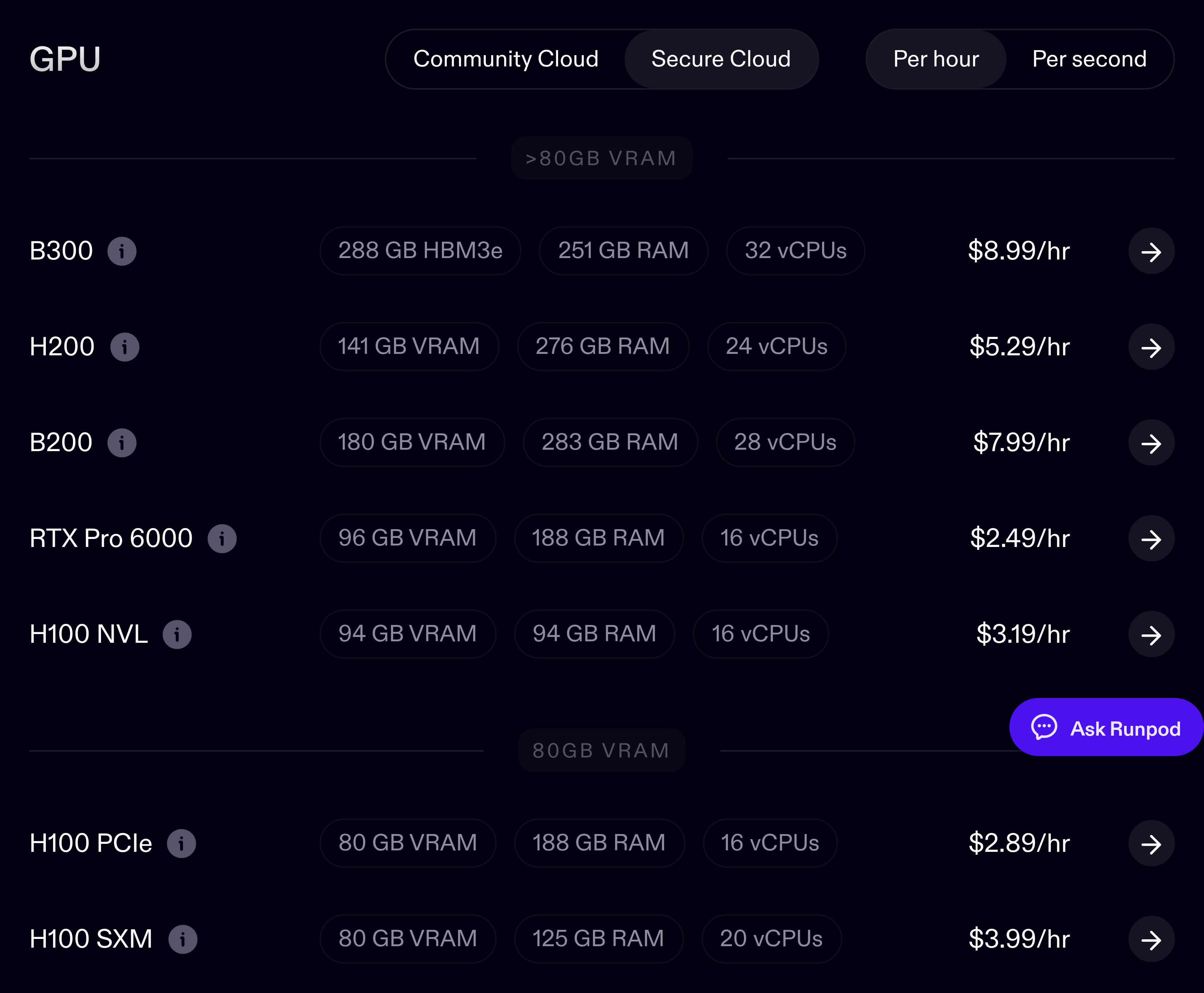
So the first question about any GPU quote is which tier it is, because a tier mismatch manufactures a spread that is not there. The second is whether it is a rate at all. The cheap end of this chart is RunPod's $2.69, and RunPod's own FAQ words it as "from $2.69/hr" — a floor. Load the page and the H100 SXM reads $3.99, because Secure Cloud is the default and $2.69 lives behind the Community Cloud toggle.
What to decide
- Find out which tier you are on. Not which provider — which tier. On-demand list is the default for every account that never asked.
- Price one eviction. How many GPU-minutes does a restart cost, per run? Until that number exists you cannot evaluate spot. With it, the decision takes an afternoon.
- Separate the workloads. Batch training, evals, fine-tunes and offline inference are the restartable set. Customer-facing serving usually is not.
- Price the commitment tier before the migration. A steady baseline on a three-year reservation reaches roughly the cheapest row without leaving your provider — confirm purchasability with your account team, not with a CSV.
- Then consider the provider. After the tier work, the remaining vendor gap is the smaller number, and you are comparing like for like.
Key takeaways
- The viral 4.57x H100 spread compares on-demand list prices across providers. The spread inside one provider, across billing tiers, is 5.41x.
- Azure lists the same East US H100 SKU at $12.29 and $2.27 per GPU-hour; AWS lists the same p5 instance at $6.88 and an amortised $2.59.
- Those are published rates. Spot capacity is not guaranteed and evictions are real, so the low figures cap your savings rather than describe your bill.
- Cheap tiers are unlocked by restartable jobs and term commitments — engineering and finance decisions, not supplier decisions.
FAQ
Is a spot H100 really 5x cheaper than an on-demand one? On list price, on Azure's ND H100 v5 in East US, yes: $2.27 versus $12.29 per GPU-hour on 9 November 2026. Realising it depends on spot capacity being available when you ask and on your job surviving reclamation.
Does InfiniBand explain the gap between providers? It explains about $1.23 per GPU-hour of Azure's list price — the difference between the InfiniBand SKU at $11.06 and its non-fabric sibling. Real, and a fraction of a 4.57x gap.
What is the cheapest H100 we can actually run on? Nobody can answer that from a price list, including us. It is the cheapest tier your workload qualifies for, times the probability you get the capacity. That second term is the one no chart publishes.