AI Code Review · Release Engineering · PostgreSQL
AI Code Review Ranked the Risk, Not the Cut List
A Postgres committer had Claude rank PostgreSQL 19's riskiest features. The ranking was cited in a revert — and still did not decide what shipped.
Your AI code review is doing its job. Every pass comes back with more findings, each one real, each one filed. The list gets longer, the launch date moves, and nobody in the room can say which of those findings actually has to block the release.
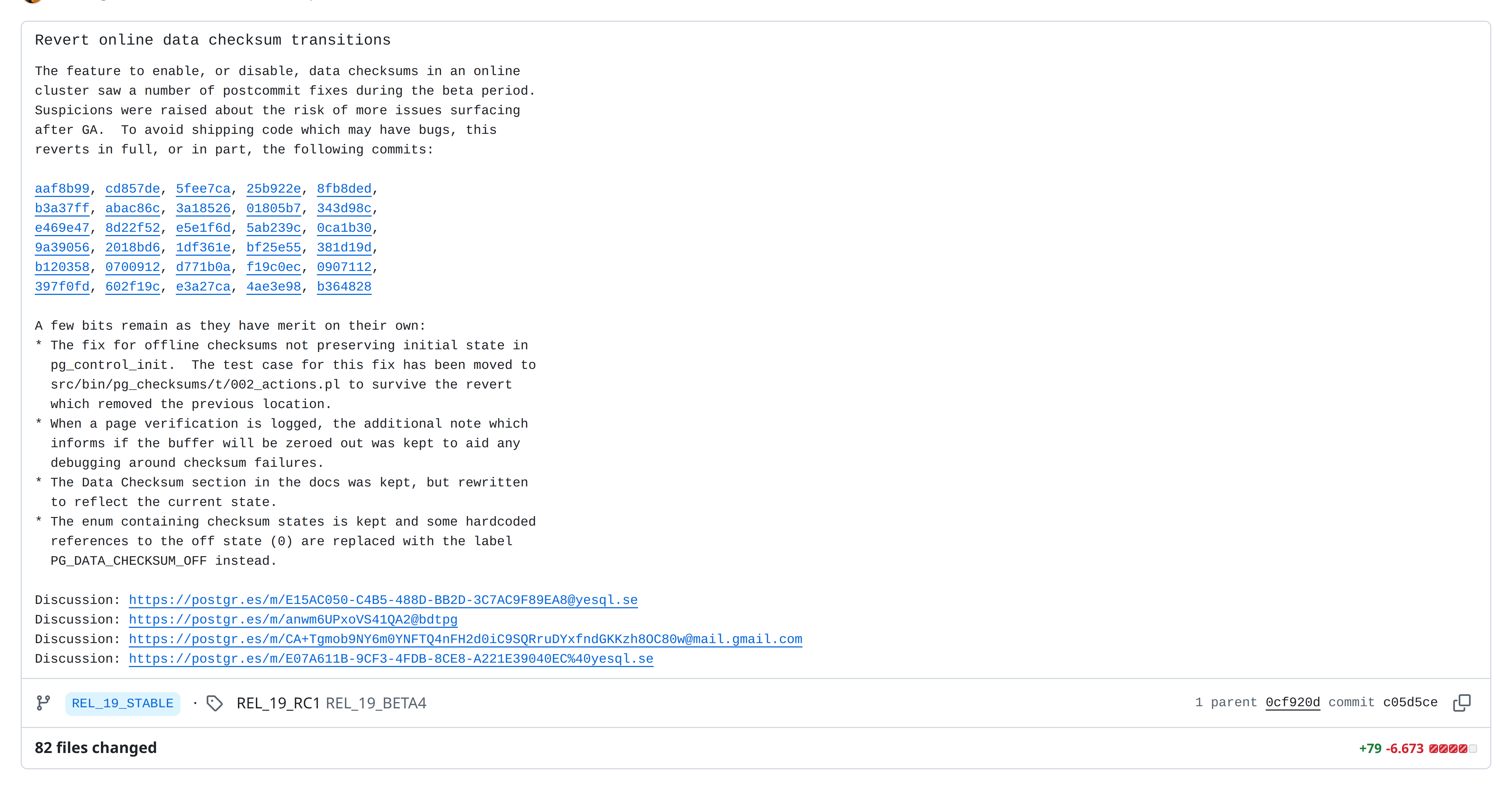
PostgreSQL hit that wall in public, with a full paper trail. During beta, over three weeks, the project deleted four finished, reviewed, beta-tested features — 44,822 lines across 305 files — and as of 2 November 2026 version 19 still has no release date. It was planned for October.
The cost to you is not the delay. It is this: a ranked defect list is not a cut list. An AI reviewer hands you a longer, better-ordered defect list, and no more ability to act on it than your architecture already allowed. On 25 August 2026, committer Robert Haas asked Claude to rank v19's features by the number and type of bugs fixed since feature freeze, and posted the ranking of six to the public pgsql-hackers list. Three weeks later that thread was cited in the commit that pulled a feature out of the release. The ranking still did not decide the outcome. Its top two shipped. Its #3, #4 and #5 came out — including one the ranking itself graded as lower severity.
What decided each feature's fate was a property fixed at design time: whether its next bug could be shipped as a patch after general availability. Get that wrong and you pay in one of three currencies: a date that keeps moving, finished work you delete, or a defect you ship and cannot patch for a full version cycle. That is the question your release meeting is actually asking, and no reviewer, human or model, can answer it for you.
What is verified here, and what is one person's inference
We pulled the commit counts from the GitHub API rather than take them on trust, and they reproduce. On the release-in-progress branch, commits over the same April-to-September window went from 738 in 2025 to 1,182 in 2026, up 60%; on the previous release's branch, 250 to 437, up 75%. Haas's published figures land within 2.5% of ours. PostgreSQL 19 also needed a fourth beta, which neither of the two previous releases did, and it has taken 149 commits on its release branch since the release candidate was tagged on 12 October. Version 18 took 64 between its own candidate and shipping 21 days later.

One derived number is worth more than all of those. Commits to master that were not back-patched actually fell, from 318 to 295. Total volume rose about 40% while new-feature work declined about 7%. Essentially all the growth is fixes being shipped back into versions already running in production.
What is not verified is the headline everyone ran with. That LLMs caused this is Haas's own attribution, not a measurement — he is an EDB committer and he published it on Neon's blog, and both are commercial Postgres vendors. His claim that "a huge number of people on the Internet" are now reporting bugs they found with LLMs has no public provenance dataset behind it; nobody can check what share of reports were AI-assisted. We also did not verify the reversion and CVE counts quoted in secondary coverage, and we will not repeat a GA date the project's own pages do not carry. Treat the volume as fact and the cause as an interested party's hypothesis.
The AI code review was right about the bugs and wrong about the release
Rank did not track outcome.
| # | Feature | Post-freeze fixes | Outcome |
|---|---|---|---|
| 1 | RI fast-path FK checks | ~16 | Shipped |
| 2 | REPACK | 28 | Shipped, headline feature |
| 3 | Online data checksums | ~25 | Cut |
| 4 | UPDATE/DELETE FOR PORTION OF | 17 | Cut |
| 5 | SQL/PGQ property graphs | 17 | Cut |
| 6 | postgres_fdw statistics import | 7 | Shipped |
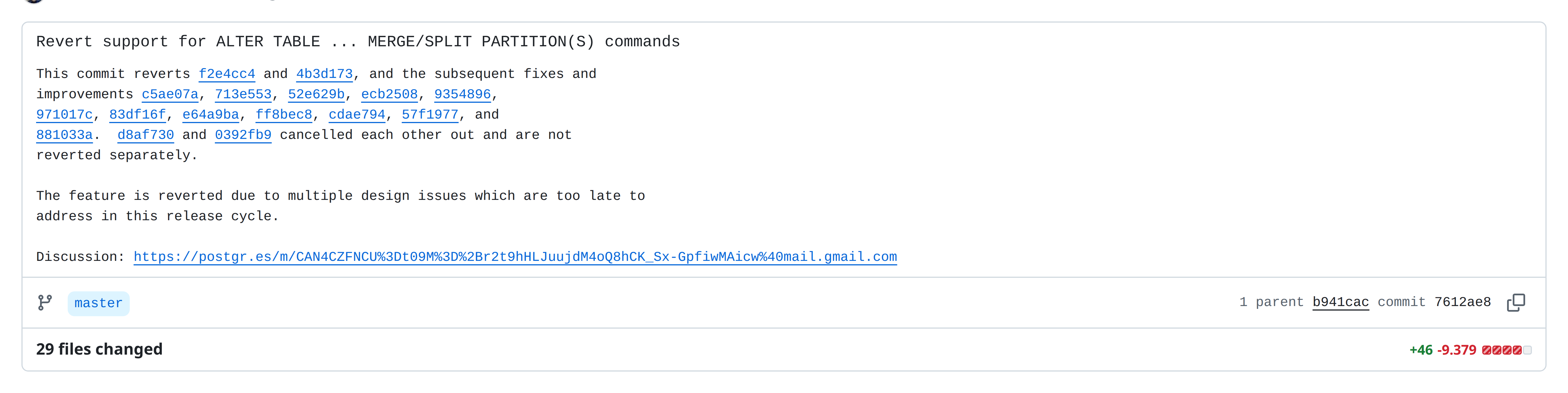
The feature with the most post-freeze fixes on the list shipped and is a headline item in the release notes. The one with the second most was cut. And the single largest deletion of the cycle — ALTER TABLE MERGE/SPLIT PARTITION, 9,379 lines, reverted one day after the ranking was posted for "multiple design issues which are too late to address in this release cycle" — was not on the list at all.
The human predictions did no better. Haas wrote he was "pretty scared about all of #1-#3"; two of those three shipped. He called #4 "relatively lower risk"; #4 was deleted. One person in the thread called his correctly, by asking a different question. Tom Lane feared SQL/PGQ not for its bug count but because the fixes still under discussion "require parsetree and/or catalog changes and thus catversion bumps" — meaning any bug found after release would be "unfixable until v20."
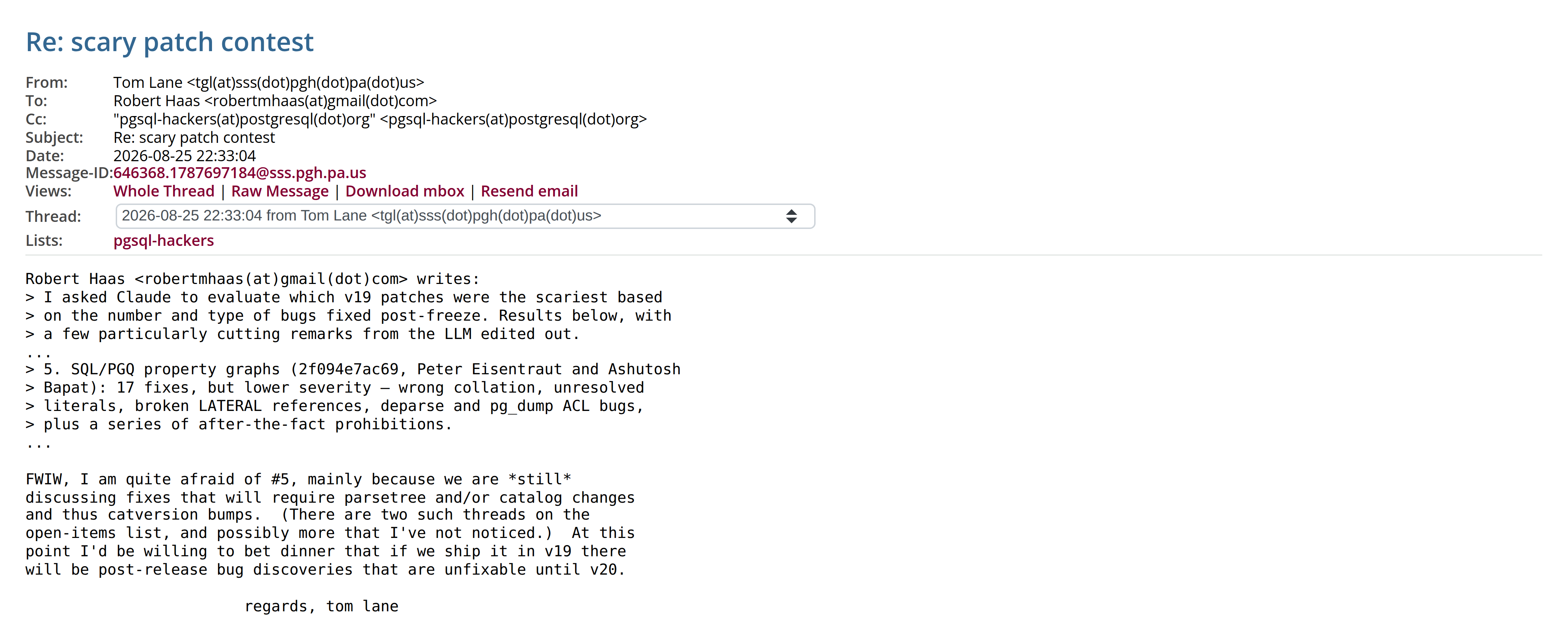
That is the rule that decided everything. A catalog change cannot ride a minor release, so a bug in a catalog-touching feature is unshippable until the next major version — a year of customers running a known defect. Features whose future fixes were ordinary patches shipped with bugs still open, and two kept producing serious ones deep into the candidate period: RI fast-path took a crash fix on 6 October, and REPACK was still taking fixes on 27 October. Features whose future fixes were not patchable were deleted, however mild their current bugs looked.
The cheapest cut was an unplug, not a revert
The clearest evidence is the removal nobody wrote about. Online data checksums was reverted on the REL_19_STABLE branch only. Master still declares pg_enable_data_checksums and pg_disable_data_checksums and still carries datachecksum_state.c; neither appears anywhere in the release branch. The feature was not abandoned — it was unplugged from one release and kept for the next. We found that by diffing the two trees; it appears in none of the coverage we read.
That same commit is the one citing the AI ranking, and its stated reason repays a close read: "Suspicions were raised about the risk of more issues surfacing after GA. To avoid shipping code which may have bugs…" Risk of future bugs, not a count of past ones. And the move was available only because this feature could be detached from one branch while living on in another. That separability is a design decision. No amount of review creates it.
What to decide before your next release
Do this before the release, not during it: write down which parts of it can be unplugged late.
For each feature, one question. If this breaks a week after launch, can we fix it without a migration, a schema change, or a breaking API change?
The features where the answer is yes are your real scope-cutting budget — the only things you will be able to drop when the findings pile up. The ones where the answer is no are features you are committing to support broken for a full version cycle, and their risk has to be spent before the code is written: a narrower surface, a flag that disables the path, a separate table, a versioned endpoint.
Then run the AI review and read it for what it is: evidence about features you already know you can cut. It is an excellent defect generator and a poor prioritiser. PostgreSQL has thirty years of process and committers who do this full time, and it could still only cut what was separable. A startup eight weeks from a funding milestone will not do better. It is the same discipline behind how we contain AI-written code before production, and it matters more now that agents write a large share of pull requests — and it is the work we do.
Key takeaways
- An AI reviewer multiplies findings, not decisions. Rank in PostgreSQL's LLM-generated risk list predicted no cuts: #1 and #2 shipped, #3 through #5 were deleted.
- The criterion that decided was post-GA fixability. Catalog changes cannot ship in a minor release, so a catalog-touching feature's next bug stays open for a year.
- Separability is architecture, set at design time. Online data checksums survived as a v20 feature only because it could be removed from a single branch.
- 44,822 lines of finished, beta-tested work were deleted in three weeks by the most process-heavy project in software. Your team has less room, not more.
- Label every feature patchable or not before the next release. That list is your scope-cutting budget. The AI's findings are not.