AI Search · Pricing · Go-To-Market
AI Can't Read Your Pricing Page. It Quotes a Number Anyway
When an AI assistant can't read your pricing page it quotes G2 or a competitor instead. Three fixable gates, and the three checks that find them.
A buyer asked an AI assistant what your product costs. It gave them a number — specific, confident, with a citation. You have never published that number.
That is the ordinary case now. When an assistant cannot read your pricing page it does not say "I don't know." It answers from whatever it can read: a review site, a reseller, a competitor's comparison table. So publishing a machine-readable price has stopped being a marketing preference about lead qualification. It is the only control you have over what buyers are told you cost — and on well-known sites today that control is routinely broken by three fixable things: a robots.txt rule, an HTTP 403, and a price that only exists after JavaScript runs.
The anchor is set before anyone calls you
The expensive part is not the wrong number. It is who chose it.
If the assistant quotes G2, your next sales conversation opens against G2's figure. Your rep spends the first ten minutes arguing with an anchor nobody on your team approved, and the discount discussion starts from there. If it quotes a competitor's comparison page, the anchor is the one your competitor built to make you look expensive.
There is also nothing to go fix downstream. In the audit behind this post — a vendor's own single run, more on that below — when the answer did not cite the brand's own site it cited 737 other domains. The largest single substitute, G2, accounted for 4.6% of 1,382 outside citations — Capterra 3.9%, SaaSworthy and TrustRadius 2.5% each. No listing is big enough to be worth claiming. The only page you control is yours.
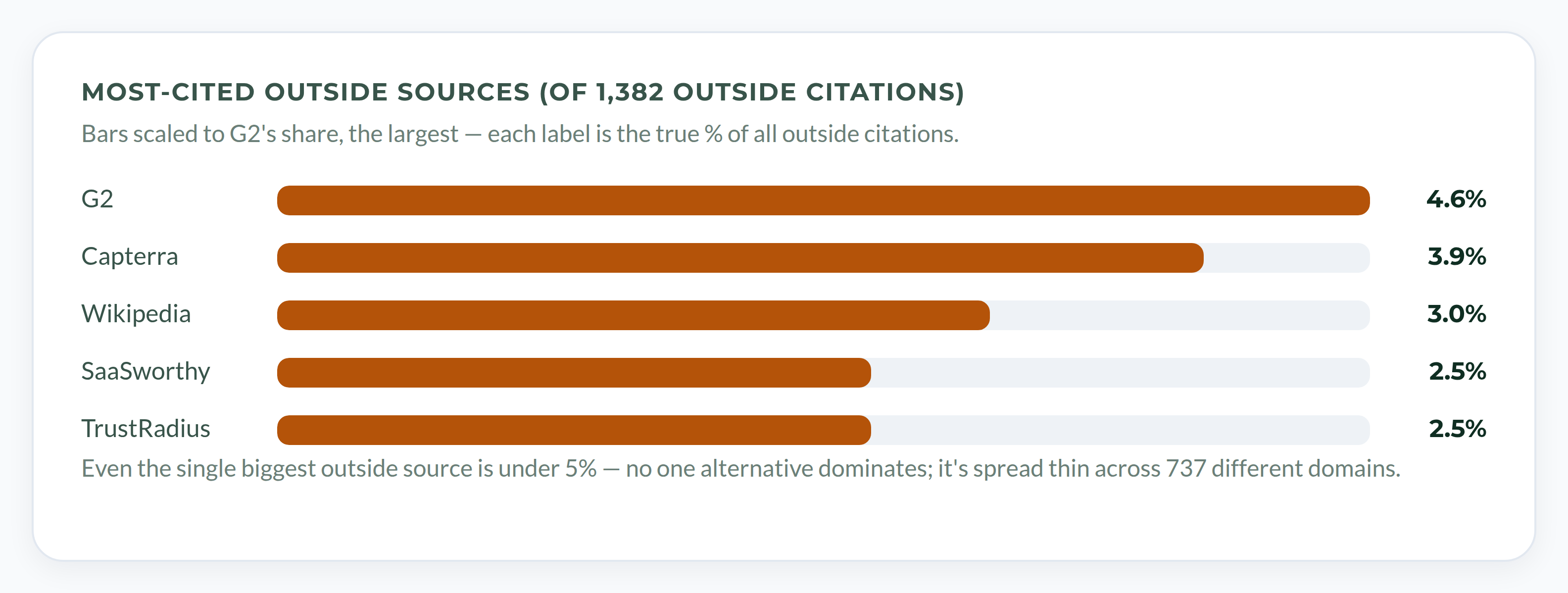
When the assistant does not cite your site, it cites 737 others. No single one is big enough to go fix.
The volume arrives this quarter: Adobe forecasts a record $275.1 billion in US online holiday spending, up 6.7% year over year, with AI-driven visits to retail sites up 130%. Treat that growth rate carefully — Adobe never says what share of total traffic AI referrals represent, so a big percentage can start from a small base.
Which numbers here are checked, and which are the vendor's own
This post rests on two different kinds of evidence, and you should know which is which.
The audit rates are BeSeenByAI's own measurement: 1,101 pricing pages, a single run in September 2026, every company anonymised "by policy" — and BeSeenByAI sells the audit that fixes the problem it measured. Its own methodology calls the control group directional and admits a single run measures nothing over time. None of it is independently reproducible. It does at least have a deposited identity, which is more than most vendor research offers: DOI 10.5281/zenodo.23282396.
The named-company checks in the next section are ours, run on 14 November 2026. That part you can repeat in an afternoon.
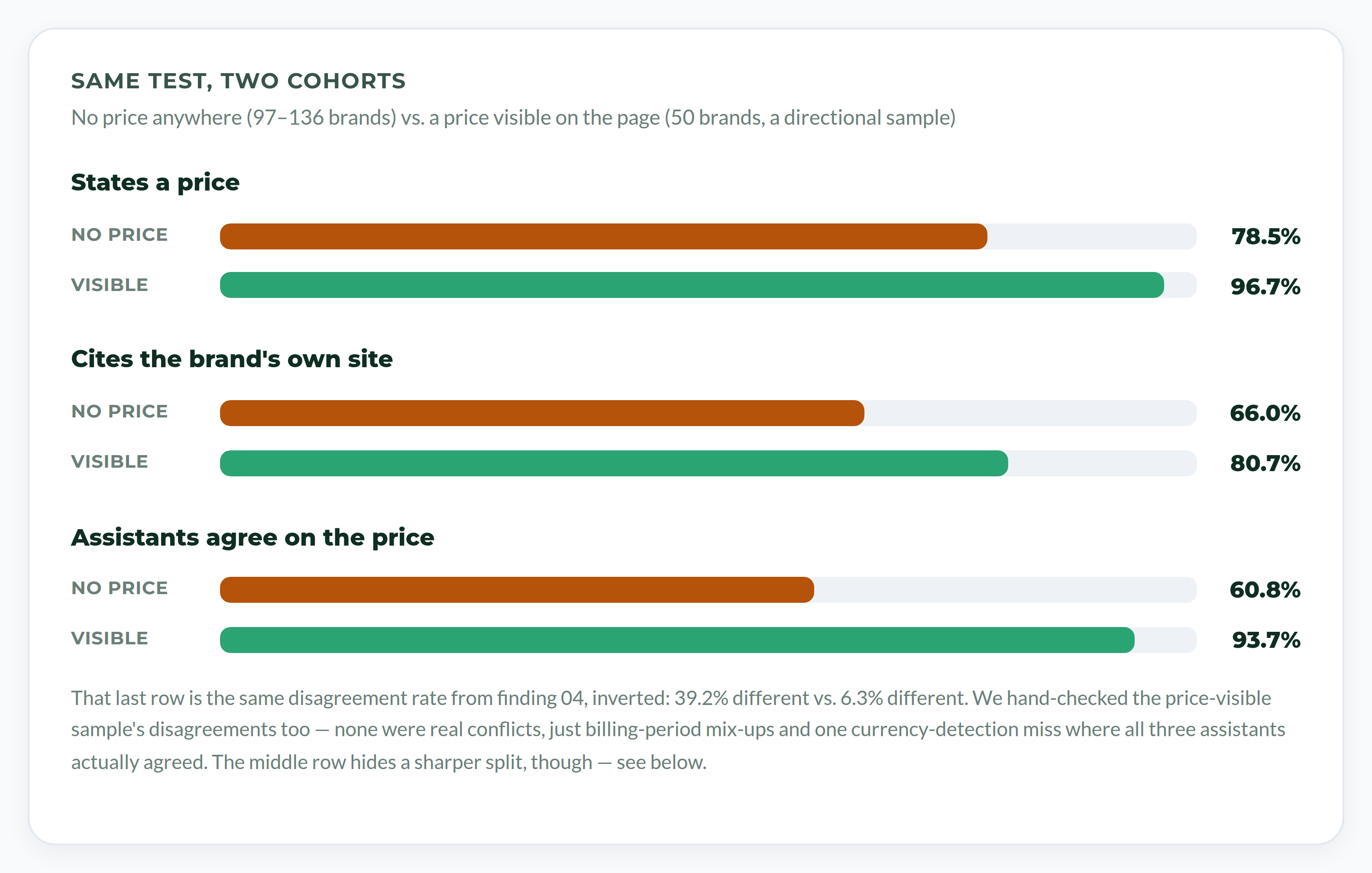
With the caveat attached, the study's central comparison is still the clearest statement of the problem. Same pricing question, three assistants, two cohorts: brands with no visible price, and 50 brands whose price sits in raw HTML a bot can fetch.
Same question, two cohorts: when the price is in the raw HTML, assistants agree on it 93.7% of the time instead of 60.8%. From BeSeenByAI's Invisible Price Tag report, October 2026.
The column that matters is not whether you get quoted — it is agreement. A readable price does not just get you into the answer. It gets you the same answer twice.
Three gates, and only one of them is robots.txt
We fetched 24 well-known pricing pages with a plain HTTP client that executes no JavaScript, using a normal desktop browser user agent. Five returned no currency figure at all in the text a non-rendering reader can extract: HubSpot, Zoom, Atlassian's Jira page, plus Canva and OpenAI, which refused the request outright. Three independent things were going wrong.
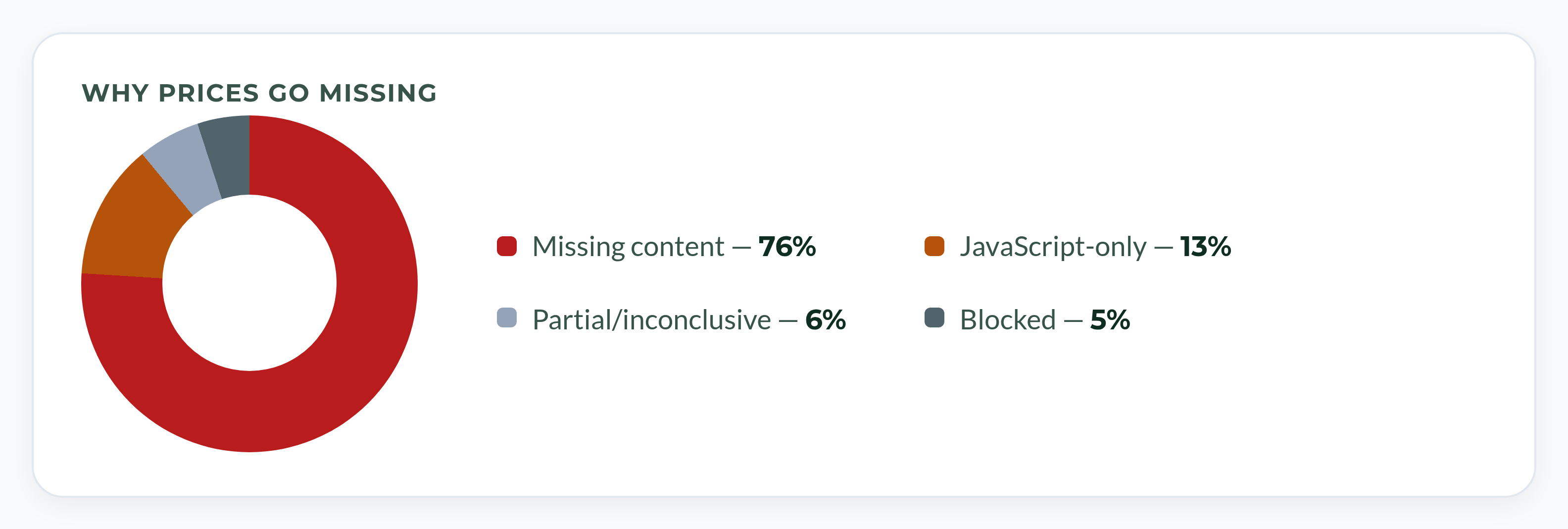
Why the price is not there: three quarters of the time the page never says it. The rest is JavaScript, partial reads and outright blocks. From BeSeenByAI's report; same caveats apply.
The page never says it. In the study, four in ten silent pages had pricing handled by sales. That is a legitimate commercial choice, but silence is not neutral — it delegates the number to whoever else is readable.
The price exists only after JavaScript. HubSpot is the cleanest case. hubspot.com/pricing returns HTTP 200 and 55,873 bytes, and once you strip script and style, the only extractable text on the page is its title: "Marketing Software Pricing | HubSpot". There is no <noscript> fallback. Render the same URL in headless Chrome and the whole ladder appears: Free $0/mo, Starter from $7/mo/seat, Professional from $800/mo, Enterprise from $3,600/mo, plus one-time onboarding fees of $3,000 and $7,000.
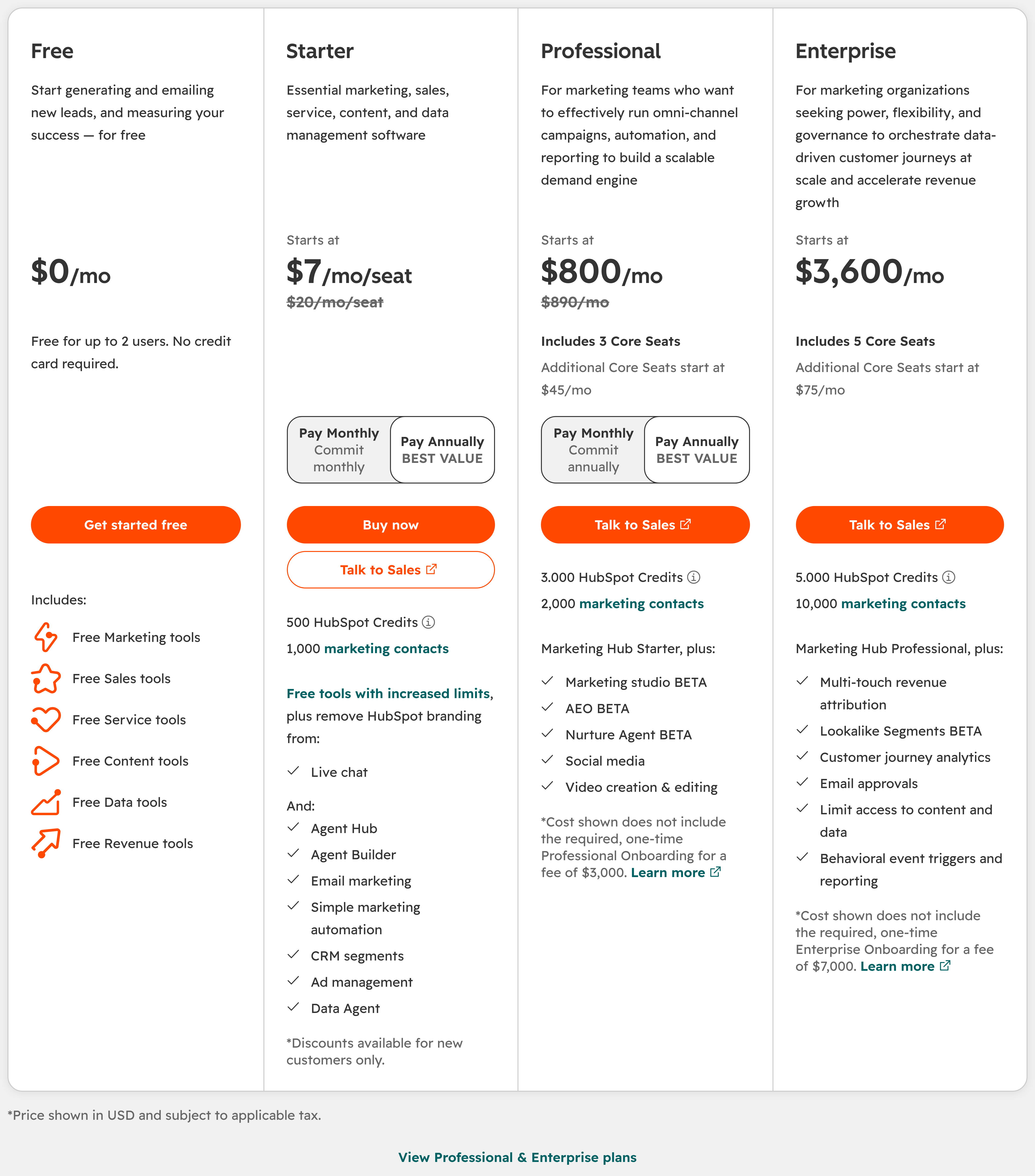
HubSpot's four tiers, as a browser shows them. Fetch the same URL without JavaScript and the only text you get back is the page title.
Neither OpenAI's nor Anthropic's crawler documentation says whether their fetchers execute JavaScript, so we cannot tell you which assistants see the empty version. What we can tell you is exactly what a non-rendering reader gets: a page title.
There is a cheap hedge, and some teams already ship it. Atlassian's Jira pricing page has no currency figure in its extractable text either — but its JSON-LD carries an Offer price of 8.48, so a machine still has something to quote. Asana, monday.com, Salesforce, Intercom and Calendly ship JSON-LD prices too. Structured data is the path that survives when the text path does not.
The request never lands. canva.com/pricing/ returned HTTP 403 to a desktop Chrome user agent and to curl alike. So did OpenAI's own ChatGPT pricing page. No crawler policy is involved; the page simply refuses anything that is not a browser session.
Then there is robots.txt, which is one gate and not the spine. OpenAI documents three separate crawlers with three different jobs — GPTBot for training, OAI-SearchBot for the search index, ChatGPT-User for a fetch a person just asked for. We wrote up that split in Your robots.txt is now a distribution strategy; the short version is that "block AI" is not one decision, and most teams making it do not know which half they bought.
Figma is what that post predicted, showing up in the wild. Its robots.txt runs 9,102 lines: the training crawlers each get Disallow: /, while one separate group covering the five assistant fetchers carries roughly 9,000 Allow: lines — including Allow: /pricing/$ in fourteen locales — closed by a Disallow: /, which is what makes it an allowlist rather than decoration. And the page pays off: figma.com/pricing/ serves the whole ladder in raw HTML with no JavaScript, from a $3 Collab seat to a $90 Full seat as the figures appear in the markup.
Canva decided the other way, also deliberately: GPTBot and ClaudeBot are disallowed while PerplexityBot sits in a group with Allow: /. Which assistant may quote Canva's price is already Canva's choice, not the market's.
Three checks, and who owns each
- Load your pricing URL with JavaScript off. If no price survives, it does not exist for a non-rendering reader. Owner: whoever owns the page. Fix: price in the server-rendered HTML, or a JSON-LD
Offer, or both. - Fetch it with
curl. A 403 or a bot-management challenge means your price is unreachable regardless of your robots.txt. Owner: platform or edge, usually not marketing — which is why nobody notices. - Read your robots.txt by crawler role. Blocking the training crawlers and allowing the answering fetchers is a coherent position. Blocking all of them is a different one, and worth making deliberately.
If your pricing really is sales-led, publish an anchor you would stand behind anyway — a floor, a band, a "starts at". It costs you nothing you were not already going to disclose on the call, and it is cheaper than a sales conversation that opens against a competitor's number.
This is not an AI problem to wait out. It is a publishing bug with a named owner, and all three checks are verifiable in an afternoon. If you want help running them against your own stack, that is the kind of production work we do.
Key takeaways
- An assistant that cannot read your price does not stay quiet; it quotes whoever is readable, and that is usually a review site or a competitor.
- There is no listing to go fix: substitutes were spread across 737 domains, none above 4.6% of outside citations.
- Three independent gates break a price: the page never says it, the price needs JavaScript, or the request is refused outright.
- A readable price buys consistency, not just visibility — 93.7% agreement across assistants versus 60.8%, by the vendor's own single-run measurement.
- Sales-led pricing is a valid choice; silence is not. Publish an explicit anchor instead.