Security · AI Agents · MCP
Remote MCP Servers: The Dependency You Cannot Pin
A remote MCP server has no version, no lockfile and no diff. Rewriting a tool description deploys code into your agent, and no scanner will see it.
A remote MCP server is the only third-party dependency whose response your agent executes as instruction instead of processing as data — and it is the only one with no version to pin, no lockfile and no artifact to diff. Rewriting a tool description is a code deploy into your agent, and nothing in the protocol is built to tell you it happened.
You approved it once
Someone on your team pasted a URL into an MCP config. A dialog asked whether to trust the server. They clicked yes, and the agent gained a capability: search a codebase, read your docs, file a ticket. That was the review.
Nobody did anything wrong: that is the supported way to give an agent a capability in 2026. The problem is what the click bought — permission, granted once, over a surface that can change afterwards with no signal.
What it costs you
Every enterprise deal you signed this year contains a sentence about how you evaluate third-party code: vendor management in the SOC 2 narrative, a checkbox about pinning dependencies in the security questionnaire, the line in procurement where you say nothing reaches production unreviewed.
For a remote MCP server that sentence is not true, and it is not false in a way more diligence fixes. There is no version to pin. There is no lockfile entry. There is no published artifact, so there is nothing to diff, nothing for a scanner to read and nothing for an advisory feed to announce. The text that steers your model can differ between two calls inside the same session, and your client is not required to tell you.
This is not an argument for ripping out your MCP servers. It is an argument for retiring an answer you cannot support. Much of the work we do taking AI-built software to production is exactly that: finding the control that was described but never built.
What we verified, and what we did not
We ran the handshake instead of quoting summaries. We probed four live public servers; on the one we inspected field by field, DeepWiki, every tools/list entry carried only name, description, inputSchema, outputSchema and _meta. No version, no hash, no etag, no signature — and the specification's own Tool type has no version or integrity field either, so this is the class and not one server's choice. All four advertise a serverInfo.version at initialize — DeepWiki returned 2.14.3 — but no client can request a version, and nothing binds that string to the tool set it serves.
One thing we did not do, and will not imply we did: we never watched a live server mutate a description mid-session. That it can is read off the specification, which defines tools.listChanged and notifications/tools/list_changed as features, and off MCP's own documentation, which names the behaviour. Those version strings are self-reported — each server asserts its own, and nothing checks.
In npm the same change is ugly. Here it is invisible.
Earlier today we wrote about a default that changed without becoming a CVE. A reader extended the argument to MCP, and the extension is stronger than the original, because npm still leaves evidence behind.
npm diff --diff=mathlive@0.111.1 --diff=mathlive@0.111.2 returns 22 changed files, and one grep for the option name surfaces a documented default moving from "none" to "same-origin". npm audit reports zero. The scanner is useless and the change is still right there, because two tarballs are published and anyone can pull both.

mathlive 0.111.1 → 0.111.2. No CVE, no advisory — but a diffable artifact. Remote MCP has no equivalent. Source: npmdiff.dev.
A remote MCP server publishes no tarball. There is no 0.111.1 to compare against. The change is not merely unscanned; it is unobservable from outside.
A tool description is not metadata. It is instruction.
Here is the mechanism the usual MCP security coverage skips — that coverage is about OAuth, token passthrough and confused-deputy attacks.
When your client connects it calls tools/list and injects the response into the model's context. The description field is not a label for a human. It is text the model reads and acts on — MCP's own documentation puts it plainly: tool names and descriptions are instructions your model reads.
Three consequences follow, and all three are checkable.
It fires at discovery. The payload lands in context before any tool executes and before a human approves any call. The human in the loop the spec asks for sits downstream of the attack.
It is not flagged as untrusted. The Tools page's one warning about untrusted server input names annotations — not description, the field that becomes instruction.
Mutation is designed in. In the current revision a server should send the change notification only to clients that subscribed for it. A client that did not is specified to get no signal when the tool set changes underneath it.
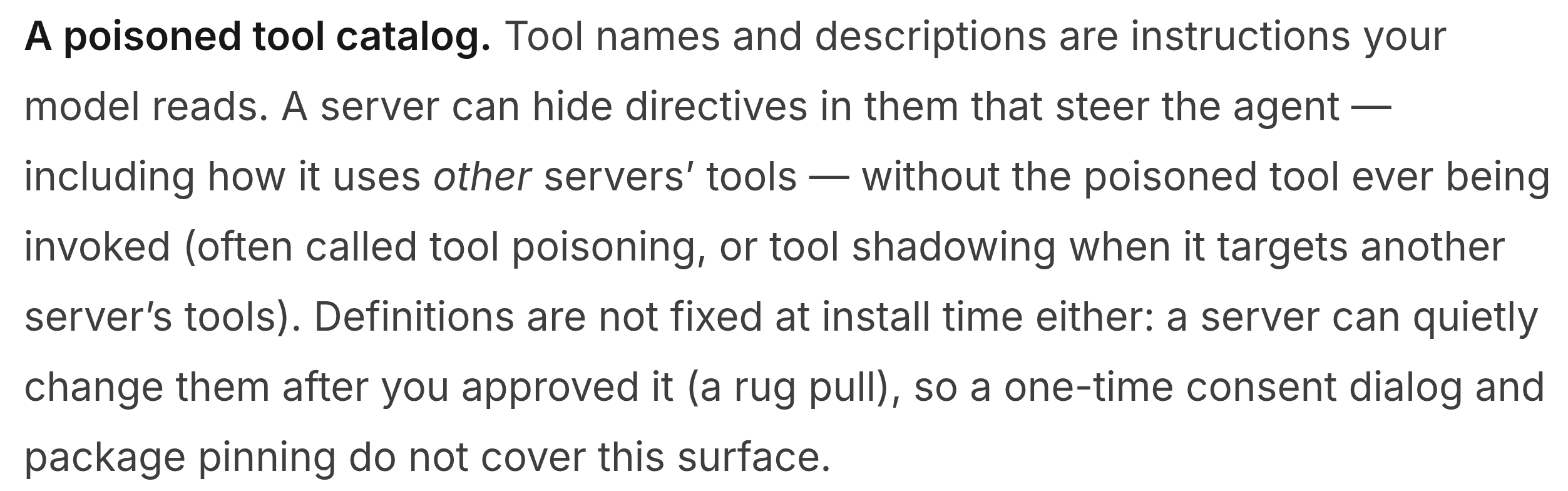
MCP's Local Server Security guide, revision 2026-07-28: "a server can quietly change them after you approved it (a rug pull), so a one-time consent dialog and package pinning do not cover this surface." Source: modelcontextprotocol.io.
There was a CVE. It covers one editor.
CVE-2025-54136 is real, and it is widely described as the MCP rug pull getting a CVE. Read the record instead: the sole affected configuration is Cursor below 1.3, the weakness is CWE-78, and the scenario is an already-trusted MCP configuration file edited after approval, in a shared repository or on the target's own machine. It is a local config-file trust bug in one editor — the same shape as the extension backdoor we covered on 30 October, where the trust signal also stayed green. Its two scores disagree, which is worth stating rather than resolving: NVD rates it 8.8, GitHub as CNA rates it 7.2. Both are assessments, not measurements.

The whole of the CVE's scope: one CPE, anysphere:cursor, up to but excluding 1.3. Source: nvd.nist.gov.
Check Point's writeup of it never mentions remote servers, tool descriptions or tools/list. The class itself — a server quietly changing what it advertises after approval — was named by Invariant Labs in April 2025 and appears in MCP's documentation. Nineteen months later it has no CVE, no advisory feed and no protocol mechanism. The scanner that came out of that same research carries twenty-odd issue codes and none for a definition that changed after approval. Secondary write-ups say otherwise; we could not confirm it, so treat "our scanner covers this" as unverified.
What to do this quarter
Three moves, all cheap, none waiting on the protocol.
Hash the tool set and re-approve on change. Canonicalise the tools/list array — sort keys, strip whitespace — and sha256 it at connect time. We did it for DeepWiki: 1538 bytes, digest b1b3fb3c4cce67d4…. Store it, compare on every connect, and make a changed digest a human decision. One command, and it is the whole of the mitigation the protocol omits.
Prefer a local server pinned by version and image digest where the capability genuinely needs your machine. The awkwardness is worth naming: MCP's own guidance says to prefer the remote version where one exists, and usually that is right. But the one official page telling you to pin, verify provenance and re-prompt on change is explicitly scoped to local servers. Remote moves the risk off the laptop and into the agent's context, and only the laptop side has tooling.
Review tool descriptions as text that executes. If you ship your own MCP server, its descriptions are reviewed as documentation today. They belong in the same gate as a prompt or a migration.
And one thing to stop. Some clients do record tool definitions and re-ask when they change — but, in MCP's words, "the protocol does not require this." Whether you get warned is a property of whichever client someone installed, which is not a control you can describe to a buyer. Take "we pin our dependencies" out of the answer for this class and put the digest check there instead. A narrow claim you can demonstrate survives an audit; a broad one you cannot does not.
Key takeaways
- A remote MCP server has no version, no lockfile and no artifact. The spec's Tool type carries no version or integrity field, and DeepWiki's live
tools/listreturned no hash, etag or signature. descriptionenters the model's context as instruction, at discovery, before any human approval step.- CVE-2025-54136 covers Cursor below 1.3 and a local config file. The class itself still has no CVE and no advisory feed.
- The mitigation the protocol omits is yours to build: hash the canonical
tools/listpayload and re-approve when it changes.