Security · IoT · Privacy
He wanted to steer his vacuum. He found almost 7,000.
A programmer tried to drive his vacuum with a game controller and cataloged 6,700 devices in 24 countries. What DJI's flaw says about everything connected in your home.
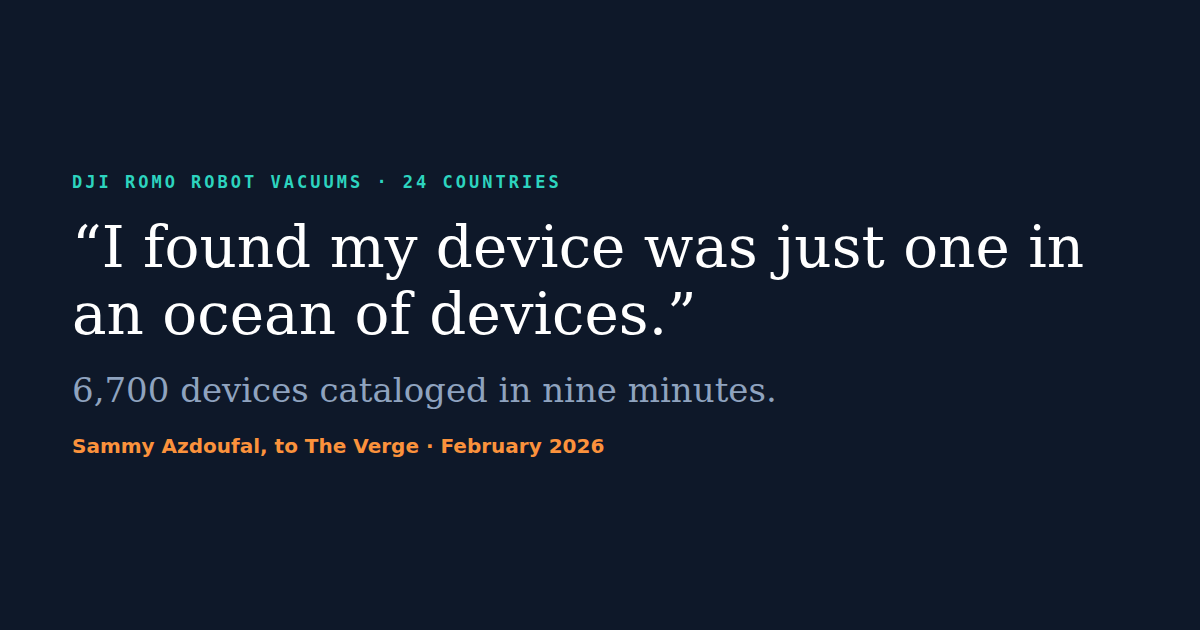
Sammy Azdoufal, a French programmer living in Barcelona, just wanted to have some fun with his new vacuum. He wanted to steer the robot with a PlayStation controller and, as he told AFP, make it sound like it was crying when the battery ran low.
Instead, his program started receiving data from thousands of other people's vacuums. When The Verge watched a live demo, his laptop had cataloged 6,700 devices in 24 countries within nine minutes. "I found my device was just one in an ocean of devices," he said.
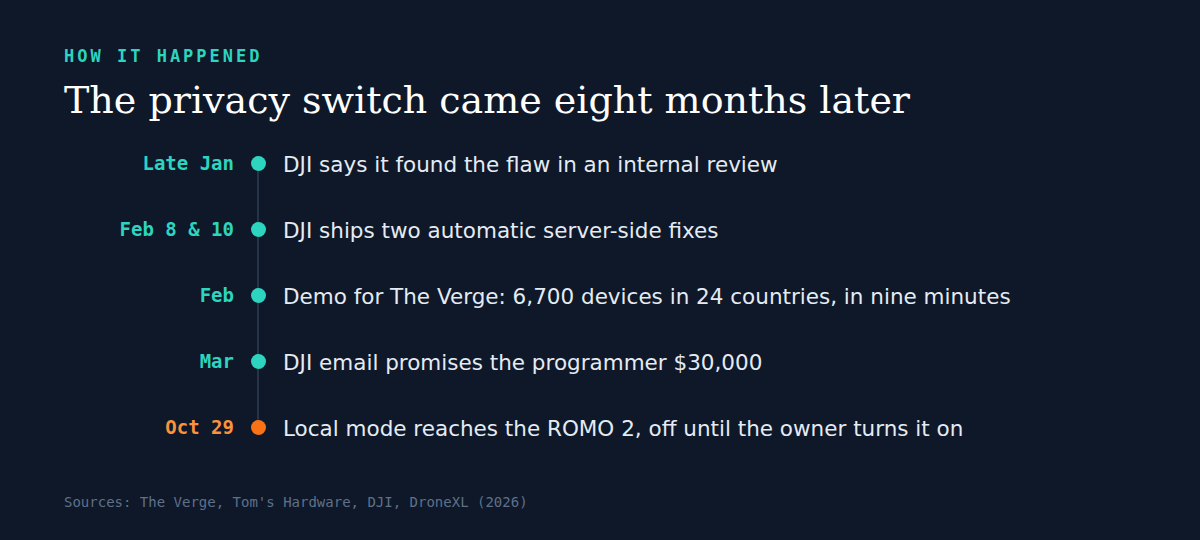
That was February. On October 29, DJI launched a mode that keeps maps and images on the robot, away from the company's cloud. It's good news with fine print: the mode ships switched off, it came out for the ROMO 2, and the announcement doesn't mention the generation of robots exposed in February.
Nobody broke into the robot. The problem was in the cloud it talks to all day. And the question it leaves applies to every device in your home: what does it do without the internet?
What happened
According to The Verge, AFP and Popular Science:
- He says he didn't break into anything. Azdoufal claims he only used his own robot's credential. DJI's servers answered as if he owned the others too.
- A floor plan appeared on screen. The Verge gave him nothing but the serial number of a review unit. With that, he saw it was cleaning the living room at 80% battery, and within minutes he generated an accurate floor plan of the home of the reporter's colleague.
- Camera and microphone are the most serious part, and the least proven. Azdoufal says he could look and listen through the robots, and that he tested this with a friend. By the day of the demo that no longer worked on The Verge's unit, because DJI had restricted that access. The reporter did watch him open his own robot's camera without entering the security PIN.
- DJI admits the flaw but plays down its reach. The company describes "a backend permission validation issue" with a "theoretical potential" for access to live video. It says it found the problem in an internal review in late January, fixed it on February 8 and 10 with no action needed from customers, and that actual occurrences were "extremely rare," nearly all from researchers.
- The first response didn't match what was seen. DJI told The Verge the issue was resolved about half an hour before the demo. It later admitted it only finished the fix after The Verge confirmed problems remained.
- The two sides disagree about encryption. The Verge reports the data was readable once connected. DJI responds that the communication was always encrypted.
- He got a reward. According to Tom's Hardware, citing an email shown to The Verge, DJI agreed to pay him $30,000, without saying for which finding.
The mechanism: one key that opened the whole building
Picture an apartment building with a front desk. Every resident has their own key, and the desk is supposed to check: this key belongs to apartment 42, so it only opens 42.
A connected robot works in a similar way. It sends what it sees to the manufacturer's server, and the owner's app fetches that information from there. The server is the front desk. From what Azdoufal describes, it looked at the key, saw it was valid, and opened every door.
Notice what that means. DJI points out that it uses encryption, and that matters, but encryption protects the road. It doesn't decide who gets in. DroneXL summed up the company's history well: the encryption was fine, the permission model was not.
And the robot's owner could do nothing. No strong password or careful Wi-Fi setup would have helped, because the error was on a server they never see.
This story is a relative of the one we told about supermarket freezers: something bought as an appliance that is, in practice, a computer on the internet. The difference is that this one roams your home with a camera and a microphone.
It isn't only DJI, either. The Verge recalls that Ecovacs robots were taken over in 2024 to chase pets and yell slurs, and that South Korean agencies flagged flaws in Dreame, Ecovacs and Narwal models in 2025.
The switch that came eight months later
Local Data Mode is the right answer. With it on, DJI says, maps and images stay on the robot, and it keeps cleaning, avoiding obstacles and returning to its dock without the internet.
But read the conditions:
- It ships switched off. You have to update the robot and turn the option on in the app's security settings. Anyone who never opens that screen stays in the cloud.
- The internet still gets in once. The first time it powers on, the robot connects to map the home.
- The announcement covers the ROMO 2 and future models. The earlier ROMO S, A and P aren't mentioned.
- There is no independent test of the mode yet. DJI cites certifications and a penetration test, but, as DroneXL pointed out, none of them evaluates this mode.
The detail that bothers us most is a different one: DJI has had this same mode on its drones since 2017. It wasn't a question of knowing how. The robot went on sale without it, and the mode only came after the scare.
The cloud isn't the villain of this story. It's what lets you check on your vacuum from outside the house, and plenty of people want that. The point is who chooses. For a device with a camera that drives through your bedroom, we think the default should be the opposite: start outside the cloud, and let people opt in.
What to do now
If you own or are buying a connected device:
- Before buying, ask what works without the internet. If the answer is "nothing," you're also buying the security of the manufacturer's server.
- Open the privacy settings on day one. Don't assume the default is the most private option. On the ROMO, for example, there are options to stop uploading obstacle photos and to delete photos after 14 days.
- Ask whether it really needs a camera and a microphone. "It's so weird to have a microphone on a freaking vacuum," Azdoufal told The Verge. According to AFP, his wife has covered the camera on the family's robot.
- Check how long the brand promises updates. Devices that stopped getting updates were part of the freezer problem.
To be honest: none of this would have protected a ROMO owner in February, because the error was on the server. What these questions do is reduce how much of your home depends on a server you don't control.
If your company makes a connected product:
- Test whether one customer's credential can read another's data. That's the test that matters here, and it can be part of your routine.
- Choose the default for the people who will never open the settings. That's most people.
- Have a channel that answers. Azdoufal wrote to DJI, got no immediate reply, and went to a journalist.
- Only say "resolved" after testing. The statement that arrived half an hour before the demo became part of the story.
If you're building something connected and want a second pair of eyes on it, see how we work.
Key takeaways
- A programmer trying to steer his vacuum with a controller cataloged 6,700 DJI devices in 24 countries in nine minutes, in a demo watched by The Verge.
- The flaw was in the server's permissions, not the robot, so owners had no way to protect themselves.
- DJI admits the problem, says the video risk was "theoretical," and says actual cases were "extremely rare."
- More than eight months later, DJI launched a mode that keeps data on the robot. It ships off and was announced for the ROMO 2 and future models.
- Before buying any connected device, ask what it does without the internet.
FAQ
Could my robot vacuum be filming me? It depends on the model and the manufacturer. Not every robot has a camera, and having one doesn't mean anyone is watching. The DJI case shows that a server error can open access without the owner noticing, so it's worth knowing what your device sends and turning off what you don't need.
I own a DJI ROMO. Do I need to do anything? For the February flaw, DJI says the fix was automatic and customers don't need to act. If you have a ROMO 2 and prefer to keep data at home, update the robot and turn the mode on in the app's security settings.
What do I lose by taking a device out of the cloud? Usually, access from outside the house. DJI says that in local mode the robot keeps cleaning and returning to its dock, and that you can start a clean without the internet. Other devices may differ, so check before buying.
Is this only a problem with Chinese brands? That conclusion doesn't hold. The Verge cites flaws across several brands, and the same kind of permission error can exist in any internet service. What matters is what the device collects and how the company controls access.