AI · Engineering Leadership · Developer Tools
Stack Overflow's Collapse Repriced Framework Choice
Stack Overflow fell to 969 questions a month. Bun has 268 lifetime, React 473,729 — corpus depth now decides what your AI assistant knows.
Stack Overflow received 969 new questions in September 2026 — its first full month under a thousand, and a 99.5% fall from the 180,913 it took in January 2016. We measured that against Stack Overflow's own API on 29 October 2026. The chart has been round every feed by now, usually with an obituary attached, and the obituary is the least useful part of it. The decline did something more concrete than end an era: it repriced framework selection, and nobody updated the checklist.
Here is the part the coverage skipped. The collapse did not land evenly across technologies, and the unevenness is generational. Your AI assistant knows a technology roughly in proportion to how much public question-and-answer material accumulated about it — and for anything that shipped after 2023, that number is close to zero and is not going to grow.
What we measured and what we are only repeating. Every figure below we pulled ourselves from the Stack Exchange API on 29 October 2026, and the queries are in the sources. Two claims in this post are not ours and are not verified: Stack Overflow's marketing copy for its new agent product — we could not load the file it points at, so we cannot confirm what it does — and the July 2026 question counts that went round the press, which trace back to one developer's query posted on X and have never been confirmed by Stack Overflow or Prosus. Both are flagged where they appear.
The cost nobody put in the estimate
Your delivery dates already assume AI-assisted throughput. Nobody writes it down that way, but the velocity your roadmap depends on is partly borrowed from a tool that is fast on some parts of your stack and slow on others — and the dividing line is not technical quality.
Two tools you could reasonably choose between in the same planning meeting can differ by three orders of magnitude in how much public material your assistant has read about them. Nothing in a normal evaluation surfaces that. You compare licence, maintainer count, benchmarks, release cadence, the shape of the API. All of those look fine on a tool released last year. The corpus does not, and nobody checks it.
When the gap shows up, it does not arrive labelled. It arrives as a sprint that runs 40% longer than the comparable one last quarter, as senior engineers spending afternoons re-deriving behaviour that used to be one search away, as a new hire who is productive on the React half of the codebase and stuck on the other half. It never appears as a line item anyone approved, because the decision that caused it was made three months earlier and looked free.
268 questions versus 473,729
Lifetime question counts, read from the Stack Exchange tag endpoint on 29 October 2026:
| Technology | Lifetime questions |
|---|---|
| reactjs | 473,729 |
| flutter | 178,571 |
| next.js | 41,491 |
| tailwind-css | 10,551 |
| svelte | 6,284 |
| langchain | 1,972 |
| deno | 1,107 |
| htmx | 602 |
| tauri | 468 |
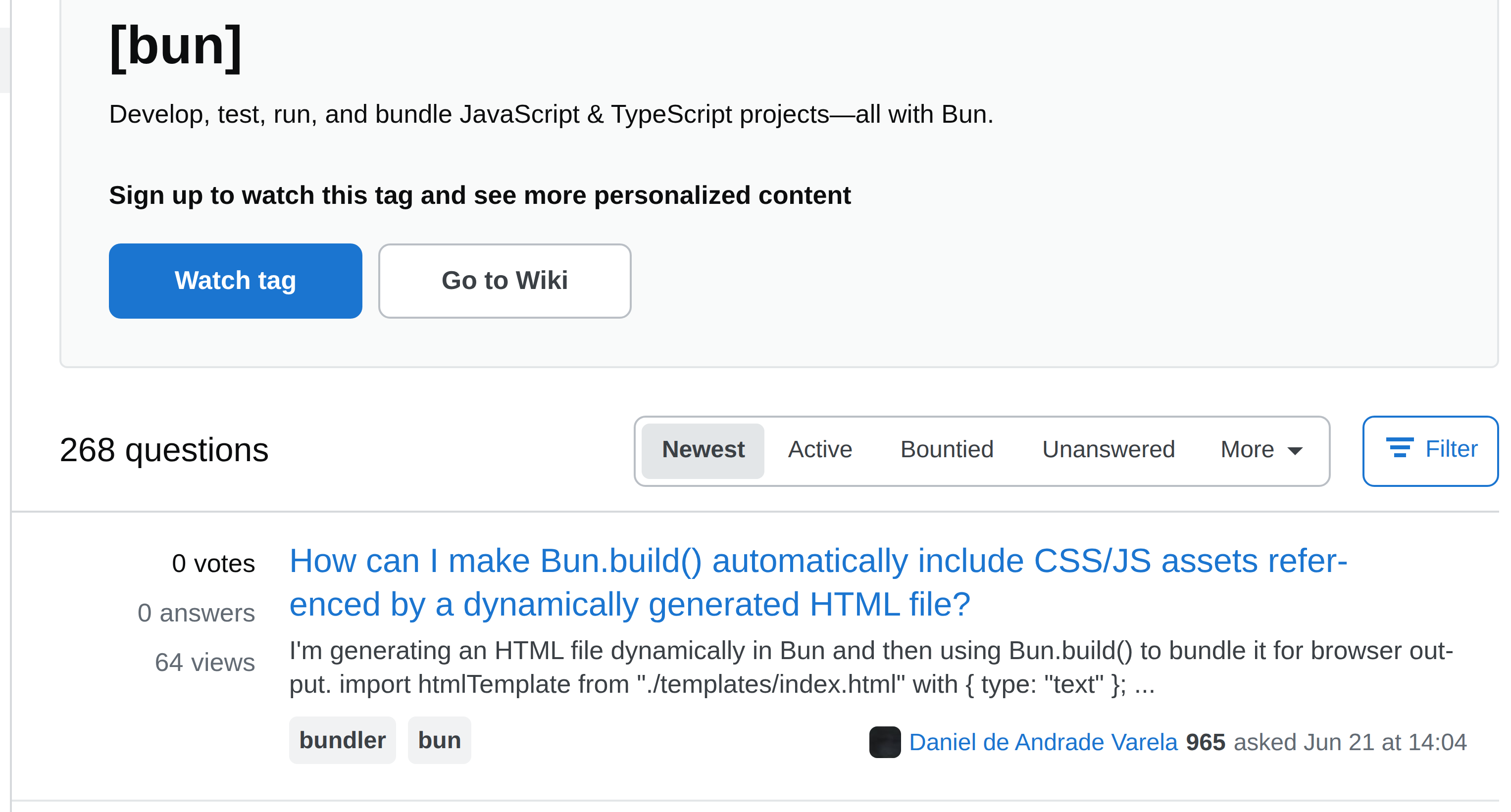
| bun | 268 |
| drizzle | 222 |
Bun is a JavaScript runtime in wide production use. It has 268 lifetime questions, and the newest on the page was asked on 21 June — four months before we loaded it. That is the entire public corpus an assistant has to reason from when your team hits something Bun-specific at 6pm on a Thursday.
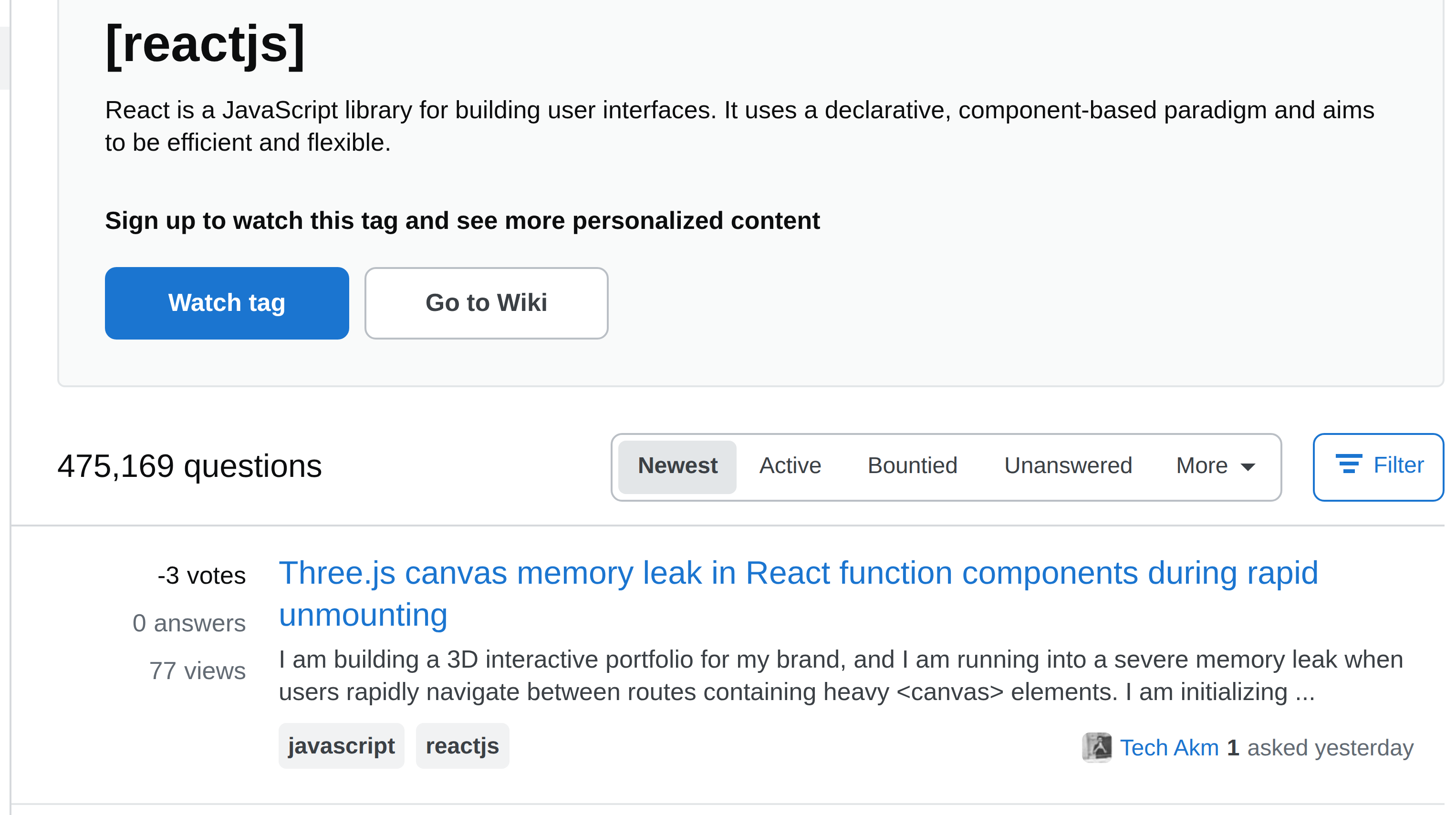
The same page for React, loaded the same day, reports 475,169 questions with the newest asked yesterday. Roughly 1,800 times the material, for a choice a team makes in an afternoon.
The obvious objection is popularity: React is simply used more. The first-24-months figures kill that reading. Questions asked in each tool's first two years after public release:
- Flutter, December 2018 to December 2020: 54,005
- React, July 2013 to July 2015: 3,392
- Svelte 3, April 2019 to April 2021: 1,488
- Next.js, October 2016 to October 2018: 445
- Tauri 1.0, June 2022 to June 2024: 332
- Bun 1.0, September 2023 to September 2025: 207
- Drizzle, September 2023 to September 2025: 169
At the same point in its life, Flutter collected 260 times what Bun did, and Flutter was not 260 times more popular in 2019 than Bun is now. Note React's own first two years, though: 3,392. The asymmetry is not that older tools started big — it is that older tools got a decade of accumulation and newer ones get none. React's 473,729 lifetime questions are ten years of people asking in public. Bun's window closed before it opened, because developers in 2025 ask a chat window instead.
The community never left. The asking stopped.
The usual story blames hostile moderation, or ChatGPT, and treats the site as dead. The answer rate says otherwise. Of questions asked in September 2016, 85.4% got at least one answer and 48.5% an accepted one. For September 2026: 74.4% and 34.0%. Lower, but nothing like the collapse in volume — people still answer what gets asked.
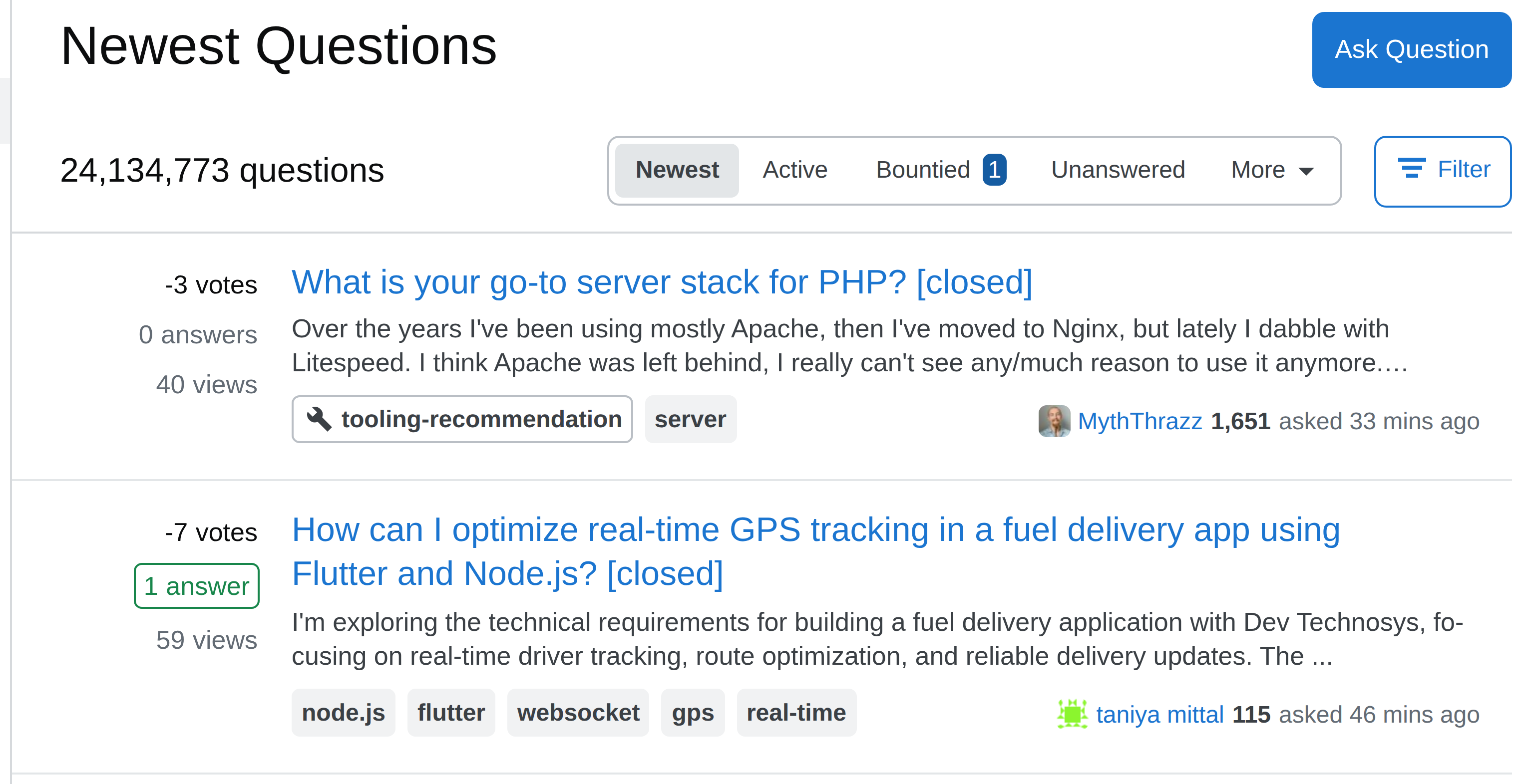
That changes the diagnosis in a way that matters for planning. The corpus is not shrinking; it is frozen at 24 million questions. React's lead is therefore permanent, and so is every 2025 tool's deficit. There is no recovery curve to wait for. Whatever a technology accumulated before the asking stopped is what your tools will know about it for the foreseeable future.
Stack Overflow is selling the archive back to the tools that drained it
Beside its question lists, Stack Overflow now runs a card for "Stack Overflow for Agents — Verified knowledge for the agentic era", carrying a prompt to paste into a coding assistant.

The pitch — "verified knowledge", support for Claude Code, Cursor, Codex and Windsurf — is Stack Overflow's own description of its product, not something we were able to check. We tried. The URL the card tells you to hand your agent answered our automated client with a Cloudflare human-verification challenge, both to curl and to a headless browser.
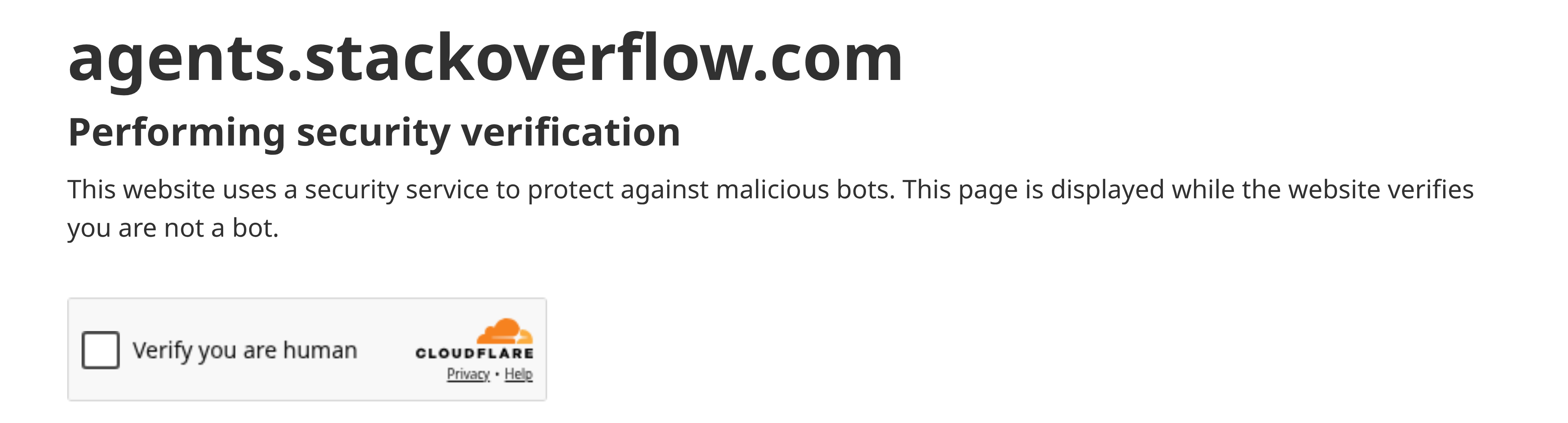
Cloudflare's behaviour varies by caller, so that is one unauthenticated client's experience, not a claim about every request. It is still worth noting that the onboarding step for an agent product was, for us, gated against agents. And even working perfectly, selling access to the archive does not address the problem in this post: the archive is the part that already exists.
Put corpus depth on the selection checklist
This is a two-minute check, and it belongs next to licence and maintainer count:
- Count the tag.
api.stackexchange.com/2.3/tags/<tag>/info?site=stackoverflowreturns the lifetime question count. Open the tag page too — the date on the newest question tells you whether anything is still arriving. - Compare at equal age, not in absolute terms. A 2024 tool with 300 questions is not behind React; it is a different category of bet.
- Price the gap instead of discovering it. Under a few thousand questions, take the AI-velocity assumption out of the estimate for that part of the stack, put a senior on it, and budget the internal documentation that has to stand in for the missing corpus — written for your assistant's context window as much as for people.
- Make it a stated trade, not an accident. A thin corpus is often still the right call; Bun is faster and Drizzle is nicer to work with. The failure is choosing it while estimating as though the corpus were there.
That fourth point is where most of our time goes when we take AI-built software to production. The same instinct that hardcodes a model name and calls it done treats assistant output as free throughput, and both bills arrive in month three. The discipline is the one that makes AI-written code safe to ship: decide what the tool is genuinely good at here, and staff the rest.
Key takeaways
- Stack Overflow took 969 questions in September 2026, down 99.5% from January 2016, but the answer rate only fell from 85.4% to 74.4% — the asking stopped, not the answering.
- Public corpus depth is the best available proxy for how much your AI assistant knows about a technology, and it is effectively frozen as of 2023.
- Bun has 268 lifetime questions against React's 473,729. At equal age, Flutter's first 24 months produced 54,005 against Bun's 207.
- Check the tag count before you standardise. Where it is thin, remove the AI-velocity assumption from the estimate rather than paying for it in month three.