Release Engineering · AI · Quality · Vendor Risk
Waymo's School Bus Recall: Shipped Is Not Fixed
Waymo closed a school bus recall with a software version. NHTSA reopened it a year later. For AI-driven behaviour, a deploy is not evidence of a fix.
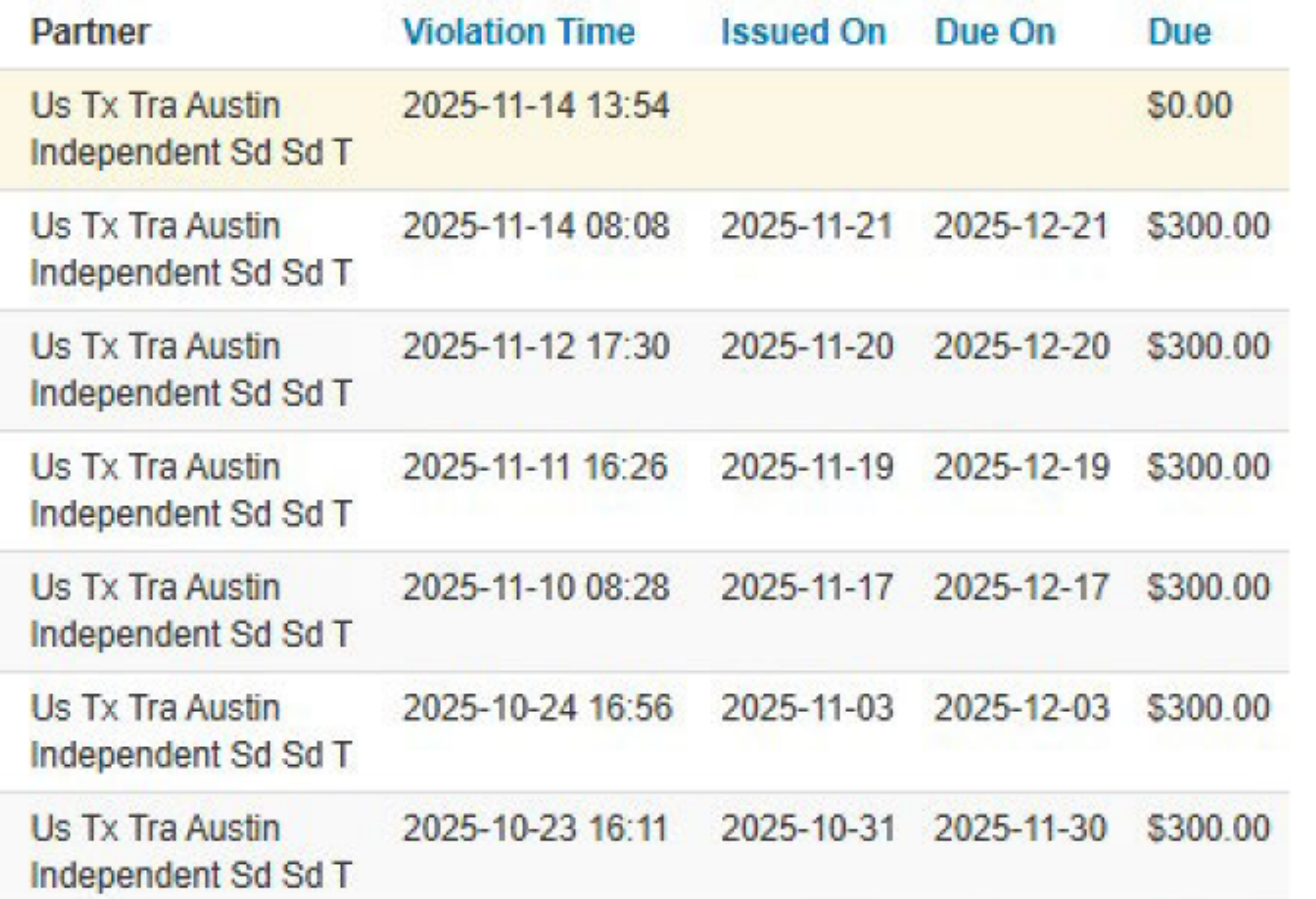
A school bus stops. The red lights flash, the stop arm swings out, and under every US state's traffic code approaching drivers are legally required to stop, because a child is about to cross. In Austin, Texas, a driverless car drove around one. In one of the incidents described in the school district's letter, now in the federal docket, the student was still in the road.
That is not the part worth keeping. The part worth keeping is that the company had already told the district it was fixed.
A recall closed by a version number is a claim, not a measurement. Waymo filed recall 25E084 in December 2025 over exactly this behaviour, and the recall closes itself in its own text. The defect: "5th Generation Automated Driving Systems (ADS) operating a software version prior to the November 5, 2025 release." The remedy: "Waymo has updated the ADS software, free of charge. All affected vehicles were repaired by November 17, 2025." On 6 November 2026 — a year later — NHTSA opened a Recall Query over 2,895 vehicles to ask whether that remedy worked. Its stated reason is one sentence: of the incidents the agency had collected, "a majority of the incidents occurred after the November 17, 2025 remedy date."

Read the recall language again and this was always going to happen. The defect is a version number. The remedy is a rollout. Both are facts about deployment. Neither is a fact about behaviour.
The bill lands on your release notes
If your definition of "fixed" is a deploy event, you have shipped a claim you cannot support — and on the day someone disputes it, their number beats yours, because you do not have one.
That is not Waymo's problem alone. It is the default state of every team shipping AI-driven behaviour right now. A deterministic bug has an honest identity between deployment and repair: the branch that mishandled the null is gone, so the behaviour is gone. A learned driving policy has no such identity. An update shifts a probability distribution over a rare event. On the day it ships, the fix is unfalsifiable — not unlikely to work, unmeasurable. The only thing that establishes it is the field rate afterwards, over a window long enough for a rare event to show up.
So "we fixed it" stops being something you assert at merge and becomes something you owe a number for later. Teams that have not internalised that are carrying an unbounded liability in their changelog, and they usually find out when a customer, an auditor or a regulator asks for the evidence and the answer is a commit hash.
What is documented, and what is a claim
This distinction is the whole post, so it applies to the post too.
From the primary record: the recall text, the three dates, the Recall Query and its stated reason, and Austin ISD's letter and violation log, all read directly in NHTSA's own filings.
From Waymo, about Waymo: that it has "made significant improvements to vehicle behavior around school buses," that it has "received no citations since March 2026," and — this one matters — that all affected vehicles were repaired by 17 November 2025. That last sentence is Waymo's own Part 573 filing content, reproduced in NHTSA's record. NHTSA is not disputing that the software reached the fleet. Whether reaching the fleet fixed the behaviour is the entire question RQ26006 was opened to answer. None of these claims is checkable from outside, for a reason I will get to.
Three dates, three meanings of "fixed"
The mechanism is easier as a sequence than as an argument. All three dates come from the primary documents:
| Date | What happened | What "fixed" meant |
|---|---|---|
| 5 November 2025 | Software release; Waymo writes to Austin ISD saying updates are "in place" | Declared |
| 17 November 2025 | Recall remedy field: all affected vehicles "were repaired" | Deployed |
| 10 December 2025 | Waymo files recall 25E084 | Filed |
The fix was declared, then deployed, then filed — and violations are recorded in the gaps. Austin ISD's letter of 20 November 2025 logs nineteen instances of Waymo vehicles illegally passing its buses since the start of the school year, averaging 1.5 per week, and says five of them came after the 5 November letter reassuring the district the issue was resolved. I counted the attached log: nineteen rows, five timestamped between 10 and 14 November.
Be precise about what that proves, because the imprecise version is rebuttable in one line. Those five rows fall after the release Waymo said had resolved the problem, but before the 17 November date on which the fleet was reportedly complete. They are rollout-window incidents. Only NHTSA's own sentence supports the stronger claim that a majority of incidents came after the fleet was fully updated.
Whoever picks the metric picks the result
Here is the part that should worry you more than the driving. The Recall Query's failure report summary prints ODI's incident count, the manufacturer's incident count and the total as CONF — confidential. The only number the public can read is 8, filed under "Other," described as traffic citations provided by Austin Independent School District.
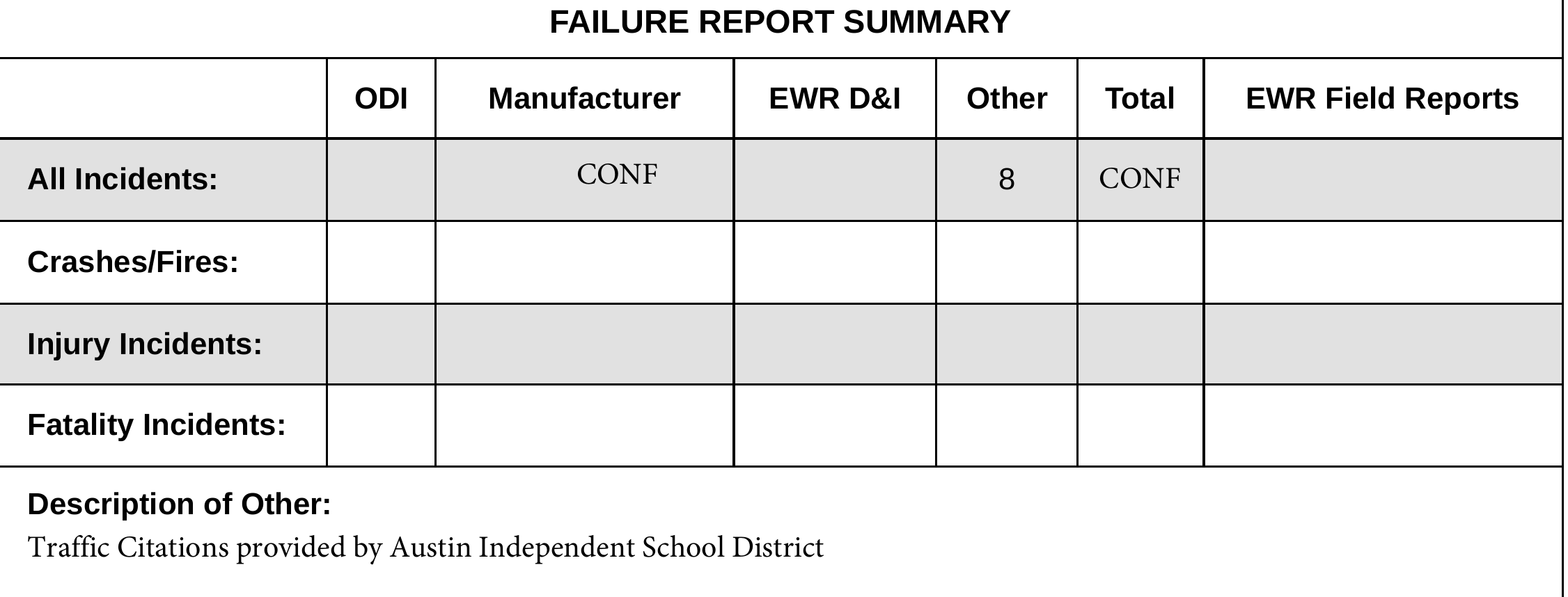
So the one auditable public metric counts enforcement activity, not vehicle behaviour. And that is precisely the metric Waymo's defence rests on: no citations since March 2026. That is not a contradiction and I am not calling it one — "no citations since March 2026" and "a majority of incidents after 17 November 2025" describe different windows and different nouns. The problem is sharper than dishonesty. Three parties are counting three different things: Waymo counts citations, the district counts observed violations, ODI counts incidents. Nobody has to lie for the public number to be the one that measures how busy the police were.
The decision, in two places
In release engineering: every fix to AI-driven behaviour gets a remedy acceptance criterion written before the deploy, with four fields and no prose — a field rate, a window, a denominator, and a named owner. "Incidents per 10,000 school-bus encounters, measured over 60 days, owned by X." Without the denominator you have a count, and a count is arguable. Without the owner the measurement silently never happens, which is the common case. This is the same discipline we keep arguing for when a demo meets production: the environment where the claim was true is not the environment where it has to hold.
In procurement: put that criterion in the contract. When you buy a system whose behaviour is learned, the vendor's incident counts may be confidential, and the only number left to you may be one that measures someone else's enforcement effort. The buyer's question is not "how many incidents?" It is "what is the denominator, and who owns the post-remedy measurement?" Ask it before signing, because afterwards you are negotiating from whichever metric the vendor chose to publish.
Key takeaways
- A recall that defines the defect as a software version and the remedy as a rollout has proven deployment, not behaviour. For probabilistic systems those are different claims.
- NHTSA's RQ26006 audits the adequacy of a remedy, not the existence of a defect. That is a regulator catching up to something AI teams already live with.
- Write the remedy acceptance criterion before the deploy: rate, window, denominator, owner.
- If the vendor's counts are confidential, the public metric will measure something else. Negotiate the denominator into the contract.
- We do this work for a living — taking AI-built software to the point where its claims survive contact with production. See how.