AI Agents · Agentic Commerce · Product Strategy
Agentic Commerce: Four Rides Measure a Waitlist
Four Uber rides and a few hundred DoorDash orders are not a verdict on agentic commerce. Both platforms still gate the write side behind partners.
Four. That is how many Uber rides an AI agent booked during the week of Halloween, out of a week Uber says carried around 320 million trips and orders. DoorDash put its own figure at "several hundred orders," in a quarter it reported 993 million. The conclusion travelled faster than the numbers did: agentic commerce is hype, shelve the integration, call us in two years.
That conclusion is wrong, and believing it is expensive. Not because the figures are wrong — because of what they measure. On both platforms, the only documented way for an outside agent to transact is partner-gated: a waitlist on DoorDash, an email to a partnerships alias on Uber. There is no open market here yet, so four rides cannot be a verdict on one.
Here is what it costs to read those numbers as demand. You defer the half of the work that is already cheap, and you budget the other half in the wrong currency. Making your catalog, pricing and availability legible to an agent is a week of engineering, reversible, and the thing already being consumed today. Getting an agent to complete a purchase on your platform is a partnership, a beta, per-user OAuth and an explicit confirmation step. Those belong in different columns of the plan. The four-rides number collapses them into one and tells you to skip both.
Where these numbers come from, and where they don't
Two different kinds of fact are in play here, and they deserve different levels of confidence.
The agent volumes are self-reported and spoken aloud. Four rides, around 500 Uber Eats orders, "several hundred" DoorDash orders — all said by executives on Q3 2026 earnings calls, all reaching us secondhand through press reports of those calls. Uber's filed Q3 press release, the 8-K exhibit on SEC EDGAR, reports 4,061 million trips, $59,819 million in gross bookings and 215 million monthly active platform consumers, and mentions AI agents nowhere. The numbers everyone is quoting live in a transcript, not in a filing: no count, no start date, no methodology, no channel breakdown. An interested party described its own new channel as small. Any ratio drawn from them — 504 agent transactions against the roughly 320 million trips and orders Uber says it handled that week — is arithmetic on company-stated figures, not an independent measurement.
What we checked ourselves is the plumbing: what each company's own developer documentation permits an outside agent to do. We loaded those pages on 5 November 2026 and captured them. That part is verifiable, and it is the part nobody else reported.
DoorDash's documented agent rail is two waitlist buttons
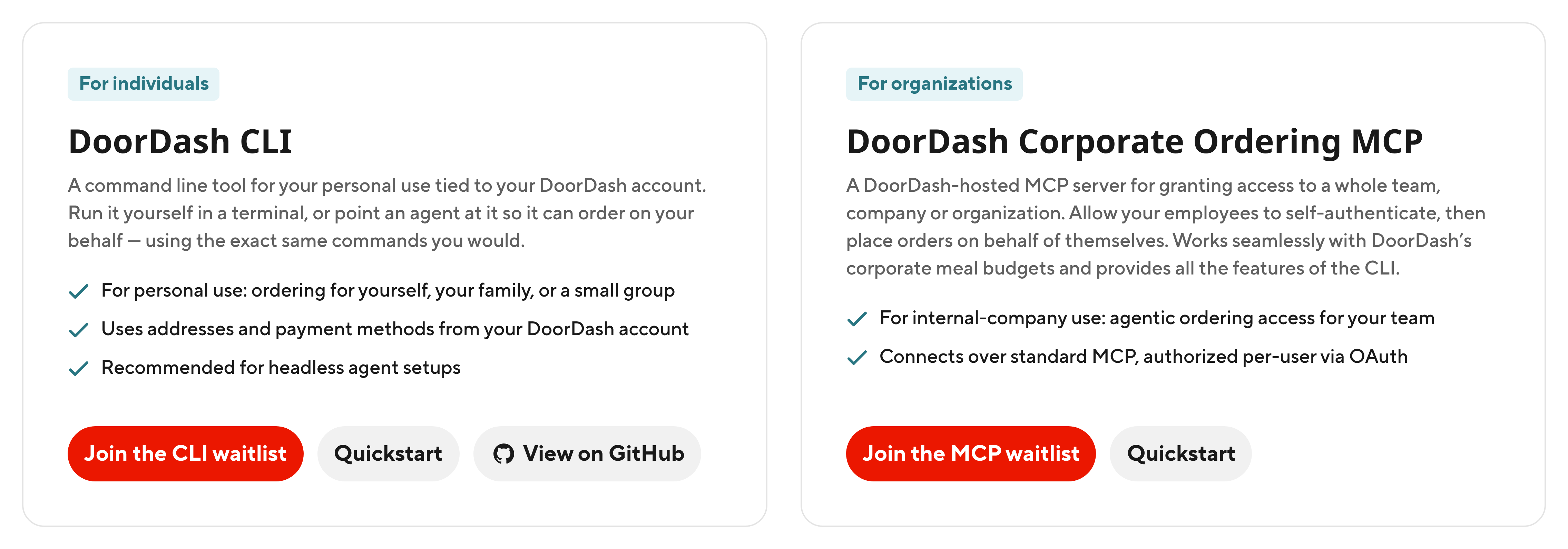
DoorDash's own agentic ordering page, 5 November 2026: the only two documented ways to connect an agent are "Join the CLI waitlist" and "Join the MCP waitlist." Source: developer.doordash.com/en-US/mcp/
DoorDash's agentic ordering page offers exactly two entry points for an outside agent. The first is the DoorDash CLI, tagged "For individuals," behind a button reading "Join the CLI waitlist." The second is the Corporate Ordering MCP, tagged "For organizations," behind "Join the MCP waitlist." The MCP card states its scope plainly: "For internal-company use: agentic ordering access for your team," connected "over standard MCP, authorized per-user via OAuth."
Read that as a founder rather than an engineer. The self-serve agent rail into one of the largest food delivery platforms in the United States is a form — and the product behind the form is for ordering your own team's lunch.
The same page carries a "Limited beta" badge beside the headline, while promising agents "the same catalog, cart, and checkout systems that power DoorDash."
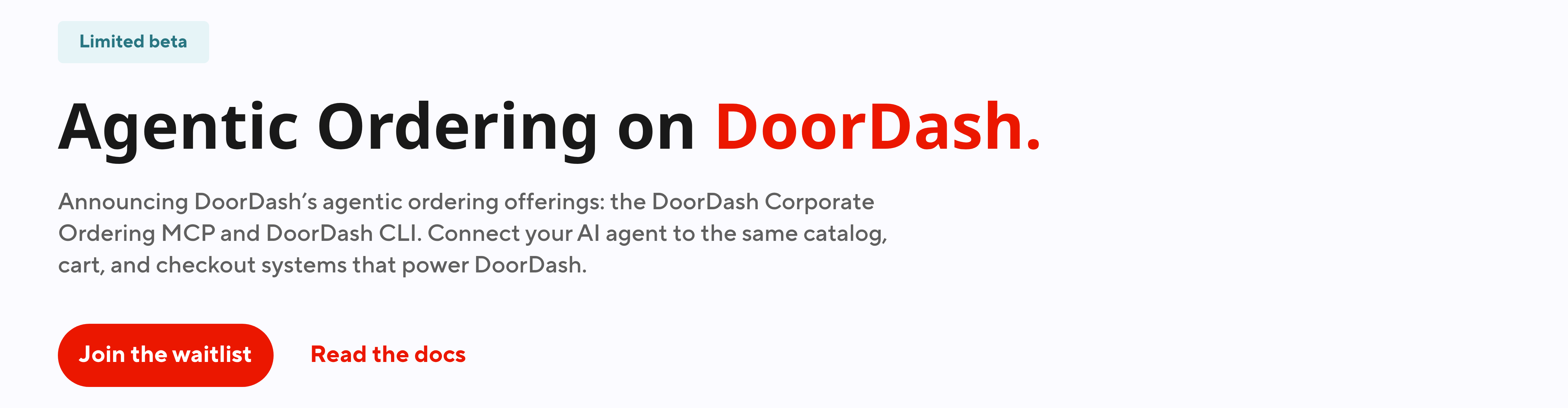
"Limited beta," stated by DoorDash on the page announcing agentic ordering. Source: developer.doordash.com/en-US/mcp/, captured 5 November 2026
And the beta is new. DoorDash's newsroom post, dated 30 September 2026, says "We're starting with a limited beta focused on companies ordering for their own employees" and "Beginning September 30, companies can join the waitlist." That is the last day of Q3, and 29 days before the earnings call where agent order volume came up.
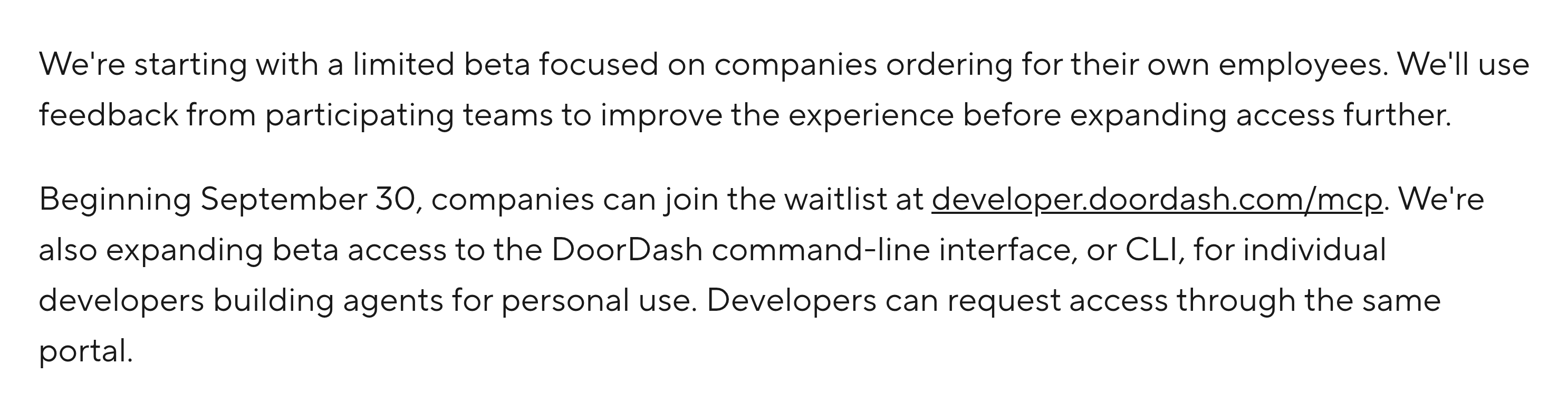
DoorDash's own newsroom post, 30 September 2026: "We're starting with a limited beta focused on companies ordering for their own employees." Source: about.doordash.com
Be precise about what that date proves. It dates the opening of the documented rail. It does not tell you which channel DoorDash's "several hundred orders" arrived through. Coverage of the call reports that consumer assistants were named — Muse and Instinct among them. Neither appears anywhere on DoorDash's developer site, and neither is among the beta partners DoorDash published for the corporate connector: SpaceXAI, Vercel, Cognition, Tempo and Mercor, all enterprise software companies ordering team lunches. So the live consumer integrations are bilateral arrangements whose access terms and start dates are not public. That is the finding, not a caveat. The number was produced by private deals, which is exactly why it is not a market signal.
Uber's agent path is an email address
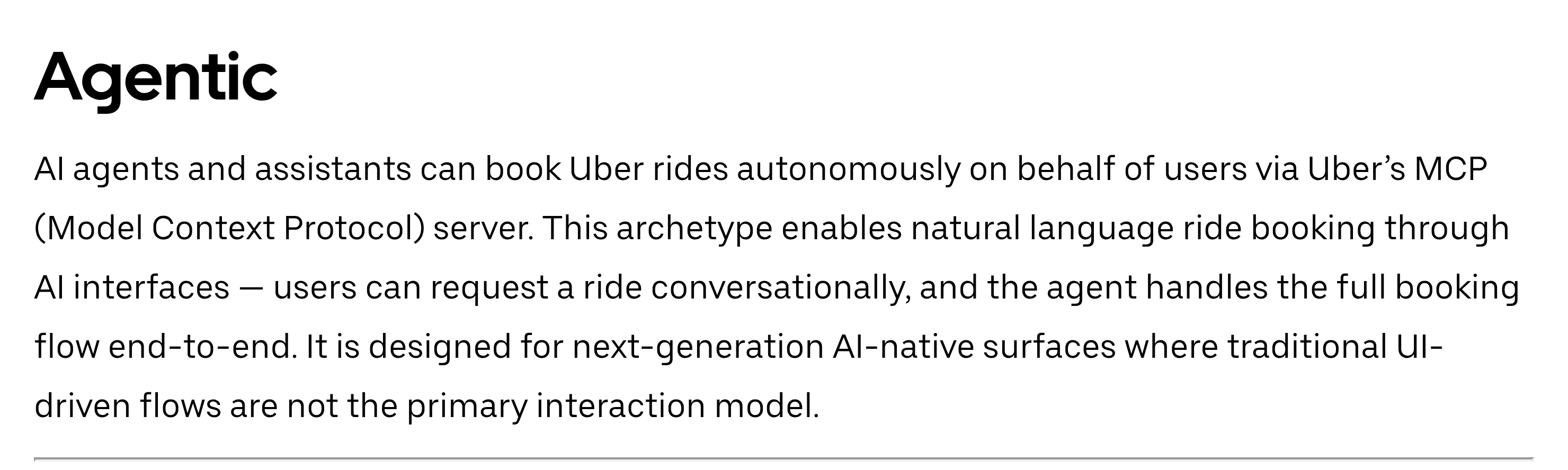
"Agentic" as Uber defines it: one archetype of a partner API. Source: developer.uber.com, 3P Demand Rides API introduction, captured 5 November 2026
Uber's documentation is just as clear once you read it instead of the headline. "Agentic" is not a product on Uber's developer site. It is one of four partner integration archetypes inside the 3P Demand Rides API: "AI agents and assistants can book Uber rides autonomously on behalf of users via Uber's MCP (Model Context Protocol) server." The API is framed throughout around "external partners," and the introduction page offers no signup of any kind. The only route in is a line of text: email a partnerships group alias.
A rail you reach by emailing a group alias is a sales channel, not a public API. Whatever four rides measures, it is not what happens when anyone can build.
The strongest argument against this post
Uber's CEO said on that same call that around eight major AI assistants are already integrated with Uber, and that "every single AI system company" is talking to them. If eight front doors are open and four people walked through in a week, the gate is not the whole story. His own reading is latency: booking a ride takes about 50 seconds in the app, reordering food about 90, and an agent has to beat that.
He is right that the app is hard to beat on a task that takes 50 seconds. But eight bilateral integrations are not a market. An integration a user has to know exists, on a surface with no habit attached, is an open door in a building nobody has been told about. Measurable demand does not come from the first integration; it comes from the hundredth, when an agent can assume the capability is there and stop asking. Nobody has shipped that, and the documentation shows why — the write side is still being rationed one deal at a time.
Split the roadmap: read side now, write side as business development
Three decisions fall out of this, and they are not the same decision.
- Keep the agent channel out of the revenue plan. On this evidence, conversion through third-party agents is a rounding error, and it stays one until the platforms open the write side. A forecast that leans on it is fiction.
- Do the read-side work anyway, now. Structured, honest data about your catalog, pricing, availability and order state, plus documentation an agent can parse. It is cheap, reversible, improves your product for humans too, and it is the part already being consumed. We end up doing this on most engagements where we take AI-built software to production, because an agent-legible API is just a well-specified API.
- Budget the write side as a business-development timeline. If the pattern holds, customers reach you through an agent only after you sign a partnership, pass a beta, and ship per-user OAuth plus an explicit confirmation step. That is quarters of relationship work and a liability conversation, not a sprint. Price the hire accordingly.
One more thing worth holding onto if you do go through a platform's rail: a remote MCP server is a dependency you cannot pin, and partner-gated access is a dependency you cannot even inspect.
Key takeaways
- Four rides and "several hundred" orders are self-reported figures spoken on earnings calls. They appear in no filing and carry no methodology.
- Neither platform runs an open agent rail. DoorDash's documented path is two waitlists, one of them scoped to internal-company use; Uber's is one archetype of a partner API reached by email.
- The read side of agent integration is open and cheap today. Do that work.
- The write side is a partnership timeline. Budget it as business development, and keep it out of the forecast.