Platform Risk · Vendor Risk · Documentation · Product Engineering
Apple Forum Shutdown: Support Knowledge You Only Rent
Apple's Support Community closes 20 November with no archive promised. What breaks in nine days, and why a hosted community is a tenancy.
You have done this. Something stopped working — the earbuds would not pair, the Mac would not wake, Mail kept asking for a password it already had — and a search dropped you onto a thread on discussions.apple.com where a stranger had answered that exact question years ago. It worked. You closed the tab and never thought about it again.
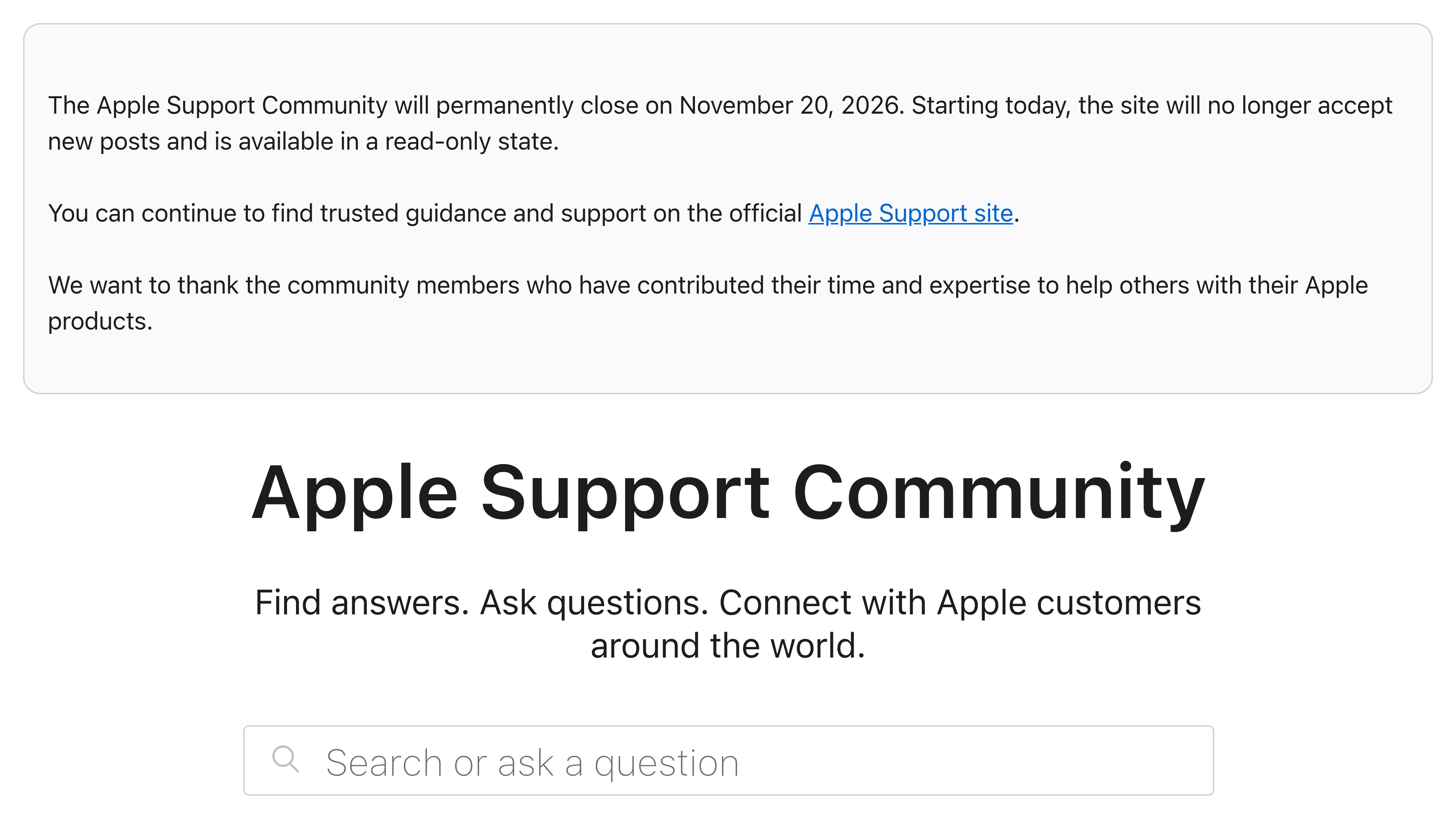
That site is scheduled to stop existing on 20 November 2026. Apple's notice reads, verbatim: "The Apple Support Community will permanently close on November 20, 2026. Starting today, the site will no longer accept new posts and is available in a read-only state." As of 11 November the site is read-only. The notice gives the date, points readers at support.apple.com, and thanks contributors. About the existing threads it says nothing at all — no archive, no export, no redirects.
So the summary most people will carry away is wrong. Apple is not archiving 28 years of support answers. It is switching off a website in nine days without saying whether the answers survive it. And that is not really a story about Apple. It is the normal end state of every community you do not host.
One thing to attribute rather than believe: Apple's stated reason — that it reached the decision after "a careful evaluation of strategy and customer needs" — is Apple characterising its own decision, given as a statement to MacRumors and relayed onward from there. We did not read it at source. Macworld, which did approach Apple directly, ran the story under the headline that the company shuttered its forums for no clear reason. That is the whole of the public explanation.
What this costs you, in nine days and after
The first cost has a date on it, and it is unglamorous: links.
Count the places your own product points at that host. Support macros your team pastes twenty times a day. The onboarding email that says "if pairing fails, see this thread." Help centre articles, in-app troubleshooting copy, the internal runbook, the README nobody owns. Those links will not degrade politely. On 20 November they stop resolving, and nothing in your stack will tell you — a dead outbound link throws no error, fails no test, and pages nobody. You find out when a customer does.
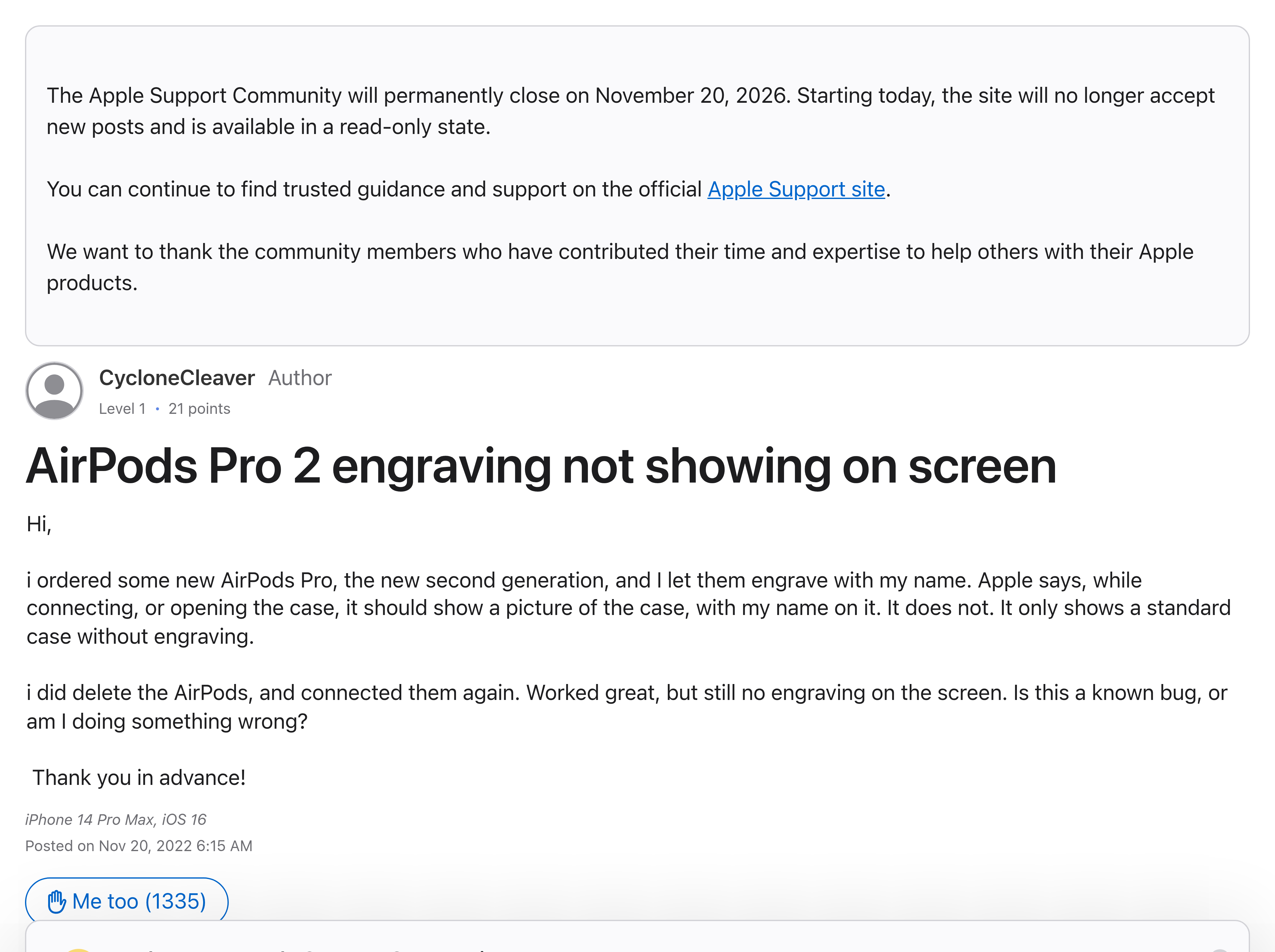
The thread above is what is actually being switched off: one question about a pair of earbuds, nine pages of replies, and 1,335 people who clicked "Me too" to say they had the same problem. That is measurable demand for a single answer, on a site holding decades of them.
The second cost has no date, which is why it is the expensive one. If your product's support knowledge lives in a vendor's forum, a Discord, a Slack or a Circle space, you do not have a knowledge base. You have a tenancy. The content is real, the traffic is real, the search equity belongs to someone else, and the lease is terminable at the landlord's convenience. Worse: the knowledge your support team stopped writing because "it is already in the community" is the part you cannot buy back later. This is the same shape as what happened when Stack Overflow's decline started quietly changing framework decisions — a corpus you rely on implicitly is not a dependency you declared, so nothing warns you when it goes.
It is a banner, not a migration
Every outlet reported the date. Almost nobody checked how the closure is being executed, and the execution is the story: this shutdown is a layer of text over a product that still behaves as though it has a future.
Directly beneath the closure notice, on the same page, the site still reads "Find answers. Ask questions. Connect with Apple customers around the world," above a field whose placeholder is "Search or ask a question." Further down it still offers to let you "find answers and ask new questions," and still advertises that you can "award points, level up, and earn new privileges" — a loyalty programme on a site with nine days left.
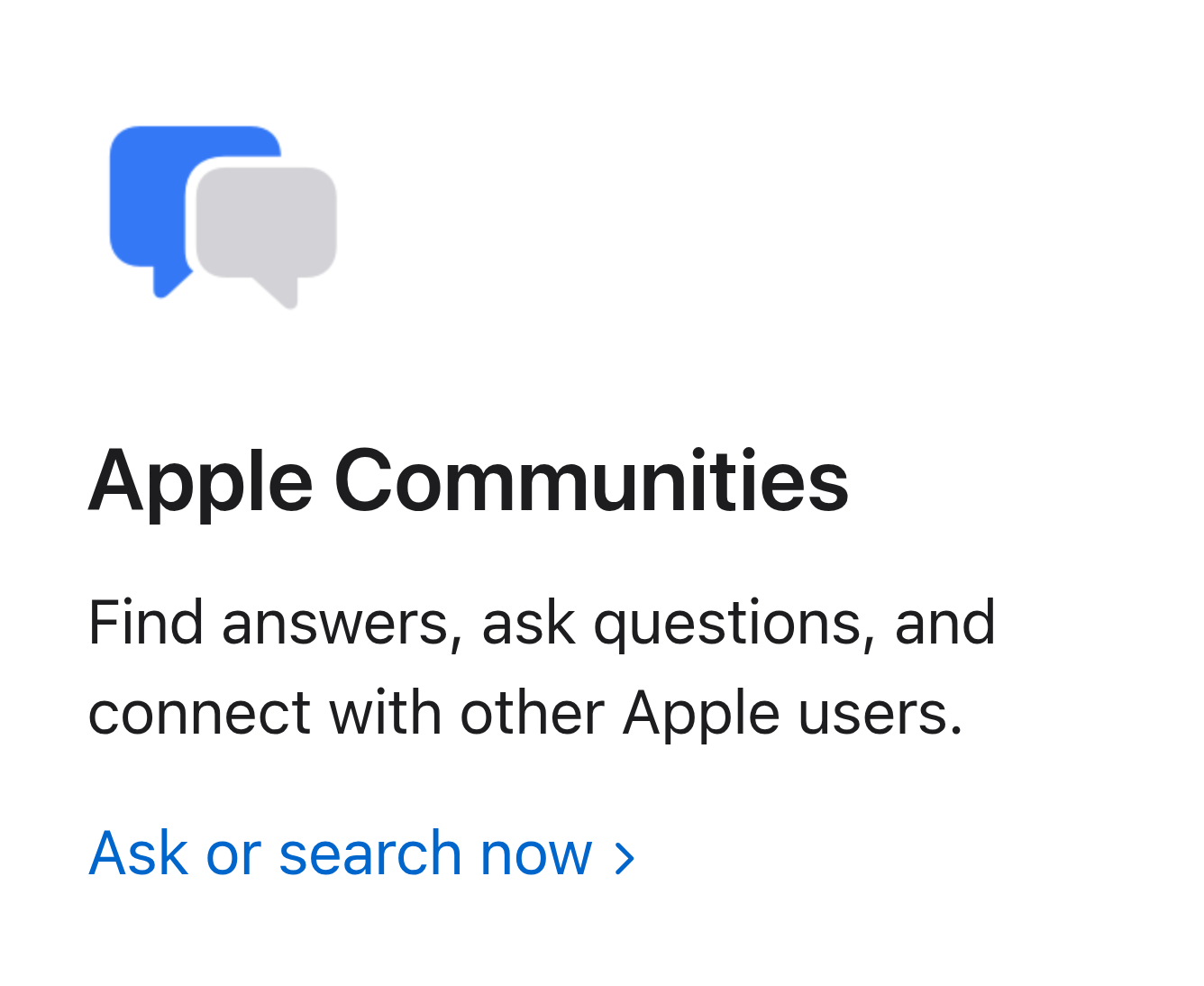
The destination Apple's own notice names as the replacement has not been updated either. support.apple.com/en-us/mac still carries an "Apple Communities" block — "Find answers, ask questions, and connect with other Apple users" — whose call to action, "Ask or search now," links straight back into the site being closed.
One practical note if you are thinking of mirroring anything: scripted requests to those thread URLs are intercepted by Apple's bot-check interstitial, which returns a byte-identical page for every thread ID we tried. The content is reachable in a real browser and not by a naive crawler. "We will just script it over the weekend" is not a nine-day plan.
Why "it is on the Internet Archive" is not an answer
It is the reflex everyone has, and it does not survive contact with the data. On 11 November we sampled 10,000 indexed URLs for those threads from the Internet Archive's index. They resolve to 2,583 distinct threads — roughly four index rows per real page, because the index is dominated by query-string variants of the same thread. One single thread accounts for 138 of the 10,000 rows.
Be careful what that does and does not prove. It does not prove the archive is missing most of the forum; we did not measure that, and the long tail is unknown. It proves something more awkward: the index overstates distinct coverage by roughly four times, so nobody can tell from the outside what is actually preserved. Capture also skews toward heavily visited pages, which means the obscure thread that solves your specific problem is the one least likely to be there. An archive you cannot audit is not a backup. It is a hope.
The nine-day decision
Concretely, before 20 November:
- Search your own surfaces for the host — docs repo, help centre export, support macros, email templates, in-app strings, marketing site. One repository-wide search for the domain plus one search in your help desk covers most of it.
- For each hit, decide: delete the link, replace it with a page you control, or copy the substance of the answer into your own docs and cite the thread as its origin. Rewriting the answer in your own words is the only one of the three that still works in 2027.
- Fix the direction of the dependency. Your docs may cite a community; they should not depend on one.
The question to ask before you stand up a community
The structural decision is the one worth taking from this, and it is a procurement question, not an engineering one: before you launch a community, decide who owns the export and where the content physically lives.
Ask the vendor for the export format, not for the promise of one. Run it once, on day one, and put the output somewhere you control. Then decide deliberately which classes of knowledge are allowed to live only there — because a community platform with no export is not a growth channel, it is a content liability running on somebody else's shutdown schedule. The same reasoning applies to audiences you reach through channels you do not own, which is the argument we made about AI search and referral traffic.
Undeclared dependencies like this one are part of what we inventory when we take an early-stage or AI-built product to production — that is how we work.
Key takeaways
- As of 11 November, Apple's Support Community is read-only, and Apple's notice says it closes permanently on 20 November with no mention of an archive, an export or redirects.
- Apple's stated reason is its own characterisation, relayed from a statement to MacRumors; the publication that asked directly reported that no clear reason was given.
- The shutdown is a banner, not a migration: the closing site still invites new questions, and Apple's own support hub still links into it.
- The Internet Archive's index overstates coverage of the forum by roughly four times, so real coverage cannot be judged from the outside.
- Any link of yours pointing at that host will 404 silently. A community with no export you have actually run is a content liability, not a channel.