Android · Mobile · Product Engineering
Google Play's Foldable Deadline Is a State Problem
From April 2027, apps that miss Google Play's Tier 3 foldable bar cannot publish or update. The work is state management, not layout.
Open your Android app on a foldable today and nothing looks broken. Unfold it halfway through a form and the typing is still there. That is not evidence your app handles the screen — it is evidence that Android has been absorbing the screen on your behalf. On 18 November 2026, Google Play put a date on when that stops.
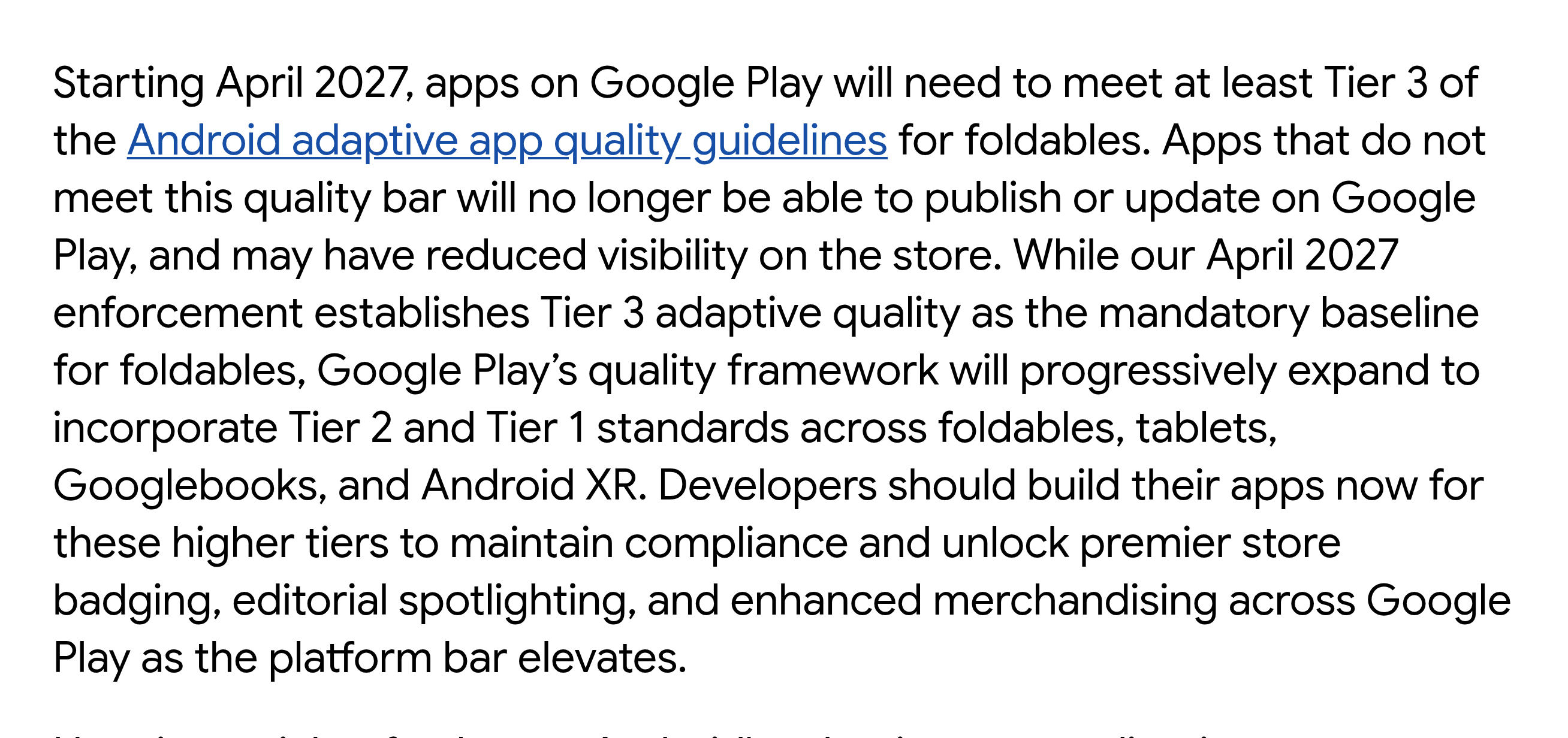
The announcement is blunt: "Starting April 2027, apps on Google Play will need to meet at least Tier 3 of the Android adaptive app quality guidelines for foldables. Apps that do not meet this quality bar will no longer be able to publish or update on Google Play, and may have reduced visibility on the store."
Every outlet filed that as a design deadline. It is a state-management deadline, and the difference is what decides how you budget it.
One note on sourcing: every date and quotation below comes from Google's own announcement and developer documentation, linked at the end. We deliberately leave out the device and app counts Apple and Google published around this news — those are vendor figures nobody has independently verified, and the argument does not need them.
What it costs you, and when
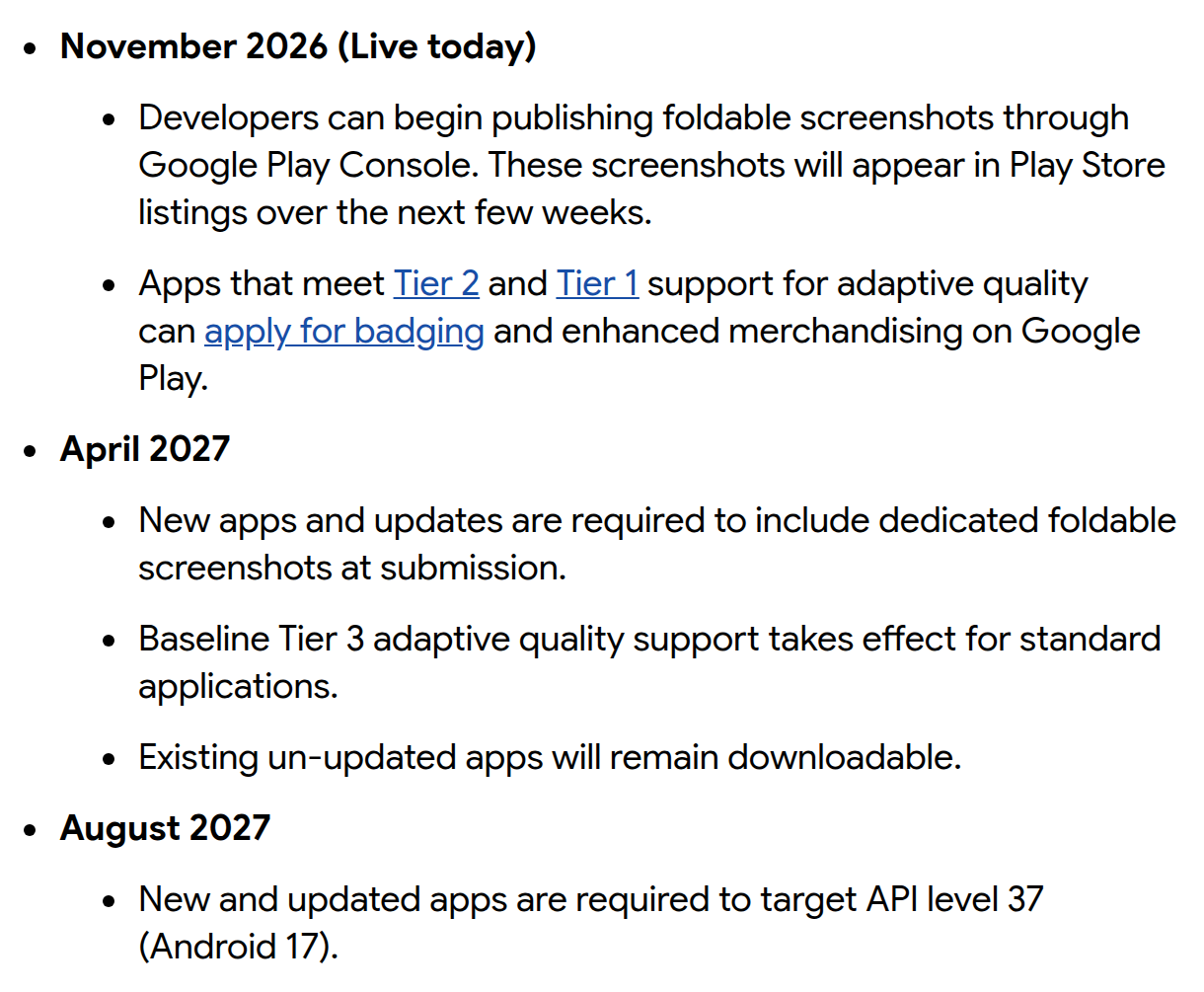
The penalty lands on shipping, not on installs. Google's milestone list says plainly that "Existing un-updated apps will remain downloadable", so nothing breaks for the users you already have. No crash report, no support ticket, no churn spike. What happens instead is that one morning in April 2027 a release is rejected, and everything queued behind it — the pricing change, the onboarding fix, the security patch — stops with it.
A frozen roadmap is a harder failure than an outage, because nobody gets paged for it.
The dates, from Google's own list:
| When | What |
|---|---|
| November 2026 | Foldable screenshots can be published through Play Console — live today |
| April 2027 | Tier 3 becomes the mandatory baseline for apps, and 3 foldable screenshots are required at submission on top of the standard 2 phone shots |
| August 2027 | New and updated apps must target API level 37 (Android 17); games must meet Tier 3 |
April 2027 is a floor, not a finish line. The same paragraph commits Play to a framework that "will progressively expand to incorporate Tier 2 and Tier 1 standards across foldables, tablets, Googlebooks, and Android XR". Whatever you build for Tier 3 is the first step of a ratchet.
The black bars were doing your state management
Folding a device is already a configuration change today. Google lists "Foldable device folding or unfolding" as a trigger of size compatibility mode, next to rotation and split-screen. The part nobody explained is what the system does with it: rather than let that change reach your code, it absorbs it.

In Google's words, when an app with a fixed orientation or fixed aspect ratio runs in a window it does not support, "Android letterboxes the app to preserve continuity." Continuity is exactly the right word. The bars are not cosmetic damage — they are the system choosing not to destroy and recreate your Activity. In that mode, recreation happens only when the user taps a restart control, which "recreates the app process, recreating the activity and redrawing the display". Today that is opt-in, by a person, with a visible button.
What Tier 3 actually asks for
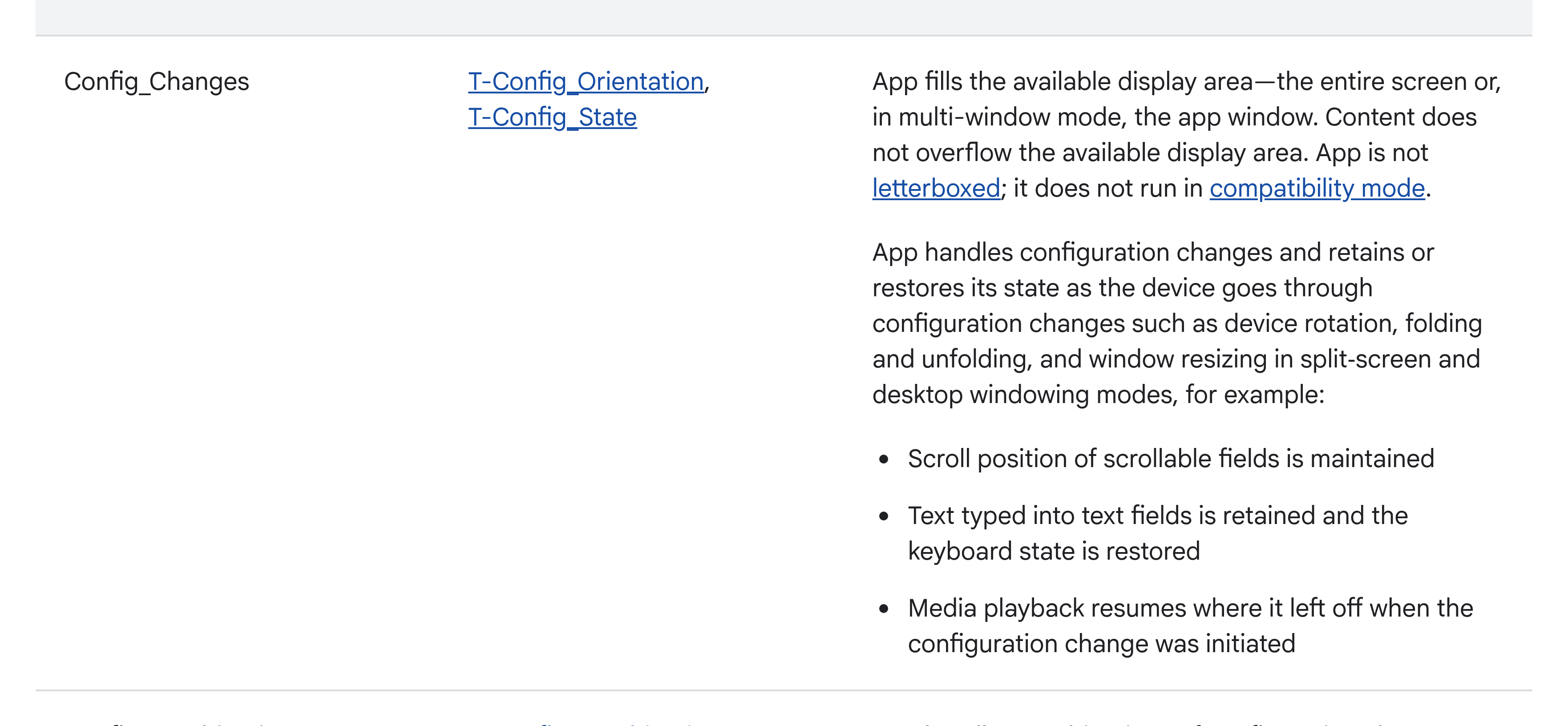
The headline requirement is the one that got reported: the app fills the available display area, is not letterboxed, and does not run in compatibility mode. The rest of the same guideline row is the actual work.
The app has to retain or restore state across configuration changes, and Google names which state: the scroll position of scrollable fields, text typed into text fields with keyboard state restored, and media playback resuming where it left off. Those three are the classic casualties of Activity recreation. Google's games guidance says it in the plainest language it uses anywhere, under "Don't": do not "restart the activity, drop multiplayer connections, or desync touch coordinates when the device folds, unfolds, rotates, or resizes."
So read the chain in order. Today the letterbox stops the configuration change from reaching your code. Tier 3 bans the letterbox. The configuration change now reaches your code, several times per session, and anything living inside a widget that gets rebuilt is gone.
That is why the work is not where the coverage put it. A responsive layout is a design task with a visible definition of done. Surviving recreation is an audit of every screen that holds a list, a form or a player, and it is invisible until a real customer folds a phone halfway through checkout.
It bites hardest on exactly the codebases we are handed: Flutter and Compose screens written fast, where state was never hoisted out of the widgets that rebuild. They demo perfectly. They lose a half-typed form the first time a device unfolds.
The decision, and why it belongs in this quarter's plan
The obvious dodge is to lock the orientation, declare the app non-resizable and keep the letterbox. That dodge is already weakening.
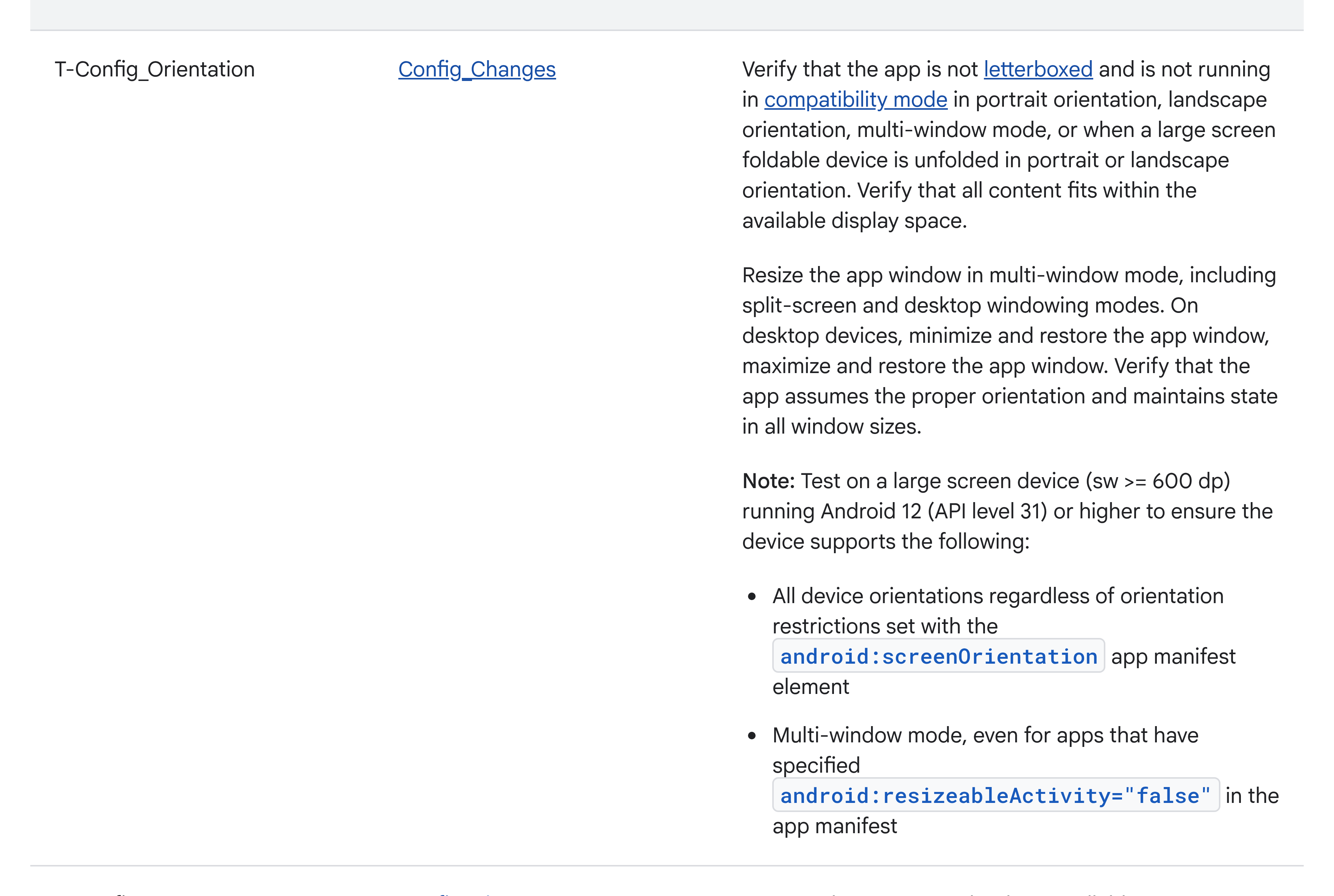
Google's Tier 3 test note says to test on a large screen device — smallest width 600 dp or more, running Android 12 or higher — to ensure the device supports all orientations regardless of the orientation restriction set in the manifest, and multi-window mode even for apps that declare themselves non-resizable. That is what the note says those devices support. The blanket version arrives in August 2027, when Play requires target API level 37, "removing developer opt-outs for orientation and resizability restrictions on large screens".
There is no version of this where you stay letterboxed and keep shipping updates. The direction of travel is worth noting too: three weeks ago, at the Android Dev Summit, this was reported as extra visibility for apps that adapt well. Today it is a publish-and-update block. Incentives became mandates in under a month, which is the same shape as Play Integrity deciding which customers can open your app.
Three questions, and they belong in the planning cycle you are running now — or Q1 2027 at the latest, not March 2027:
- Who owns the configuration-change audit? This is engineering work with a deadline, not a design refresh. If no name is on it, it is not scheduled.
- How many screens actually carry recoverable state? Count them: every list with a scroll position, every form with typed text, anything playing media. That count is your estimate.
- Is it budgeted in sprints? Foldable screenshots are a half-day. Making three classes of state survive a destroy-and-recreate cycle across forty screens is not.
If the app was built fast — by a contractor, a previous team or an agent — the audit is the deliverable, not the redesign. Apple's foldable launch already pushed app teams into the same question from the hardware side; Google is now asking it from the store side, with a date attached.
Key takeaways
- From April 2027, apps that do not meet Tier 3 can no longer publish or update on Google Play. Apps already installed keep working, so the cost shows up as a frozen roadmap.
- Tier 3 is mostly a state requirement: scroll position, typed text with keyboard state and media position must survive folding, rotating and resizing.
- Android currently letterboxes unsupported orientations "to preserve continuity", which hides the problem. Tier 3 bans the letterbox, so the configuration change reaches your code.
- August 2027 closes the manifest opt-outs through required target API level 37, and brings games to Tier 3.
- Treat it as a per-screen state audit with an owner and a sprint budget, starting with the planning cycle you are in now.